AI Appraisal Estimate

AI-generated estimates · not official valuations

From the user

What was submitted

Photo and notes provided by the user — not generated by AI

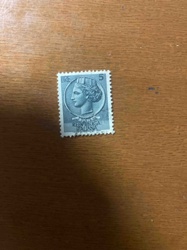
Submitted item photo
Submitted photo · June 23, 2026

User's notes

No additional notes provided.

AI analysis below

AI appraisal

AI analysis & estimate

AI-Generated · Verify before acting

Everything below is generated by AI for informational purposes only. AI can make mistakes — the AI may misidentify items or misattribute them (artist, maker, brand, designer, origin, era). This is not an official valuation and should not be used for insurance, sale, tax, estate, legal, or lending purposes — or any decision requiring a certified appraisal. It is not an authoritative claim about any person, brand, or rights holder — do not share or rely on it as a factual statement about a third party. Always consult qualified professionals before making financial decisions.

Read the full disclaimer

AI Identification

·Not independently authenticated·Verify before acting

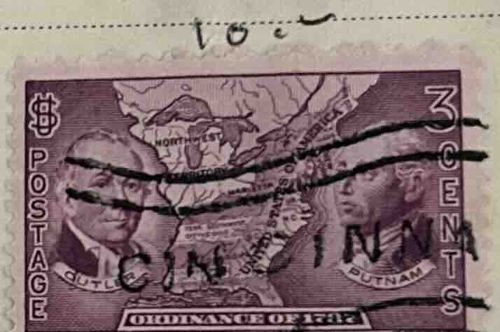
1937 Northwest Territory Sesquicentennial 3-Cent Stamp

Postage Stamp

AI Estimated Value

·Not an official valuation·Verify before acting

$0.20 - $0.50

As of June 23, 2026

AI Item Analysis

·AI can make mistakes·Verify before acting
This is a 3-cent United States postage stamp, issued in 1937 to commemorate the sesquicentennial (150th anniversary) of the Northwest Ordinance of 1787. The stamp features a central design depicting a map of the Northwest Territory, with the five Great Lakes clearly visible and labeled 'NORTHWEST TERRITORY'. Flanking the map are two prominent figures: Manasseh Cutler on the left, identified by his name below his portrait, and Rufus Putnam on the right, also with his name below. The stamp's denomination '3 CENTS' is vertically aligned on the right side, while 'POSTAGE' is vertically aligned on the left, beneath a dollar sign motif. The phrase 'ORDINANCE OF 1787' is prominently displayed at the bottom of the stamp. The stamp's color is a muted purple or plum hue. It appears to be perforated along the top and left edges, although the full extent of the perforations is not visible on the right and bottom. A notable condition issue is the presence of heavy black ink cancellation marks that traverse much of the stamp's surface, indicating it has been used for postage. These cancellation marks obscure portions of the map and the figures' faces. There is also a handwritten '10' in pencil or ink above the stamp on the surrounding paper, likely an old dealer's or collector's mark, further contributing to its unique character as a used specimen. The white border of the stamp shows some slight discoloration or toning consistent with its age. Despite the cancellation, the overall design and legibility of critical elements remain largely intact, showcasing the commemorative nature and historical significance of the stamp.
AI Appraisal Report

·AI can make mistakes·Verify before acting
This 1937 Northwest Territory Sesquicentennial 3-Cent stamp, Scott #797, is a common commemorative issue. My assessment of its condition, based solely on the provided image, indicates a heavily used example. The most significant factor impacting its value is the extensive black ink cancellation, which obscures key design elements, including portions of the map and figures. While the design and legibility of critical text are still present, the heavy cancellation detracts significantly from its aesthetic appeal for collectors. The apparent perforations are consistent with this issue, and no immediate red flags regarding authenticity are evident from the image alone. However, the presence of cancellation makes it difficult to assess fine details often used for counterfeit detection. The '10' notation above the stamp is likely a dealer or collector mark and does not add significant value. Market conditions for this specific stamp (Scott #797) in used condition are generally low. It was printed in large quantities, and used examples are readily available. There is no particular rarity associated with this stamp, even in a moderately cancelled state. Demand for heavily cancelled common commemoratives like this is minimal among serious collectors, who typically seek well-centered, lightly cancelled, or mint examples. Factors significantly impacting its low value include the common nature of the stamp itself and, most importantly, the heavy cancellation. Without physical inspection, I cannot comment definitively on paper thickness, gum (if it were unused), watermarks, or hidden flaws that might be obscured by the cancellation. A physical examination would allow for a more thorough assessment of the cancellation's depth and potential damage to the paper. Provenance documentation would be useful to establish its history, but is not typically sought for such a common item. Given its heavily used condition, its value falls into the lower end of the spectrum for this issue.

Get your items appraised

Instant estimates of your treasures with AI-powered appraisals

Browse More Appraisals