These notes were written by the person who submitted this item. Appraiser.AI has not verified them, and the AI's identification and estimate may rely on them.
AI Estimated Value
Not an official valuation
$150-250
AI estimate as of October 26, 2025 · verify with a professional before acting
AI-Generated · Verify before acting
Everything on this page is generated by AI for informational purposes only. AI can make mistakes — the AI may misidentify items or misattribute them (artist, maker, brand, designer, origin, era). This is not an official valuation and should not be used for insurance, sale, tax, estate, legal, or lending purposes — or any decision requiring a certified appraisal. It is not an authoritative claim about any person, brand, or rights holder — do not share or rely on it as a factual statement about a third party. Always consult qualified professionals before making financial decisions.
This analysis also relies on unverified notes provided by the user, which may be incomplete or inaccurate and could affect the result.
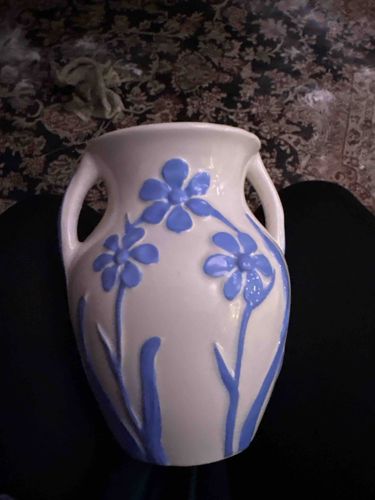
This is an art pottery vase featuring a double-handled design. The vase has a light, off-white or cream-colored matte finish as its base, upon which raised, unglazed or matte light blue floral motifs are applied. The floral decoration consists of several individual flowers with prominent petals and slender stems and leaves, all in the same light blue color, creating a three-dimensional effect. There are at least three distinct floral groupings visible on the front of the vase, with stems extending downwards. The general shape is that of an amphora or urn, with a widened body tapering towards a narrower neck and rim. Two loop handles extend from just below the rim to the shoulder of the vase, seamlessly integrated into the body. The craftsmanship appears to be folk art or studio pottery, characterized by the applied relief decoration. No specific maker's marks or signatures are visible in the provided image. The style suggests a mid-20th century aesthetic, possibly falling into the art pottery or folk art revival period. The condition appears good overall, with no obvious chips, cracks, or significant wear visible, though a full assessment would require multiple views. The matte finish and applied decoration suggest a more rustic or handcrafted appeal, rather than highly refined porcelain. The blue color against the light background provides a strong contrast and visual interest.
AI Appraisal Report
I have examined the provided image of this Art Pottery Double-Handled Vase with Applied Blue Flowers. Based on a visual inspection, the vase appears to be in good overall condition, with no immediate signs of chips, cracks, or significant wear. The matte, off-white body with the applied, raised light blue floral motifs creates an appealing, handcrafted aesthetic. The mention of its origin being Japan, combined with the folk art or studio pottery style and mid-20th-century aesthetic, helps contextualize its potential market. This type of applied decoration was popular in various art pottery movements.
Market conditions for mid-century art pottery, particularly pieces with a clear studio or folk art feel, remain steady, though not exceptionally high unless attributed to a well-known artist or studio. Comparables for unsigned, decorative art pottery vases of this era, especially those with applied elements, often sell in the $100-$300 range. The double-handled, amphora-like form and the pleasing contrast of the blue on cream add to its decorative appeal, which drives demand for such items. Rarity is difficult to ascertain without a maker's mark; pieces by anonymous studio potters are generally not rare unless unique in design or technique.
The primary factor impacting value without a signature is its decorative quality. While the condition appears good from the photo, a full assessment would require a physical inspection to check for subtle hairline cracks, restorations, or crazing not visible in the image. For full authentication of origin or attribution to a specific studio or artist, in-person examination for hidden marks, analysis of clay body and glaze composition, or documentation of provenance would be essential. Without these, it remains a charming piece of decorative art pottery, likely from Japan as stated.