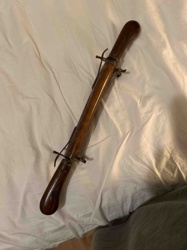
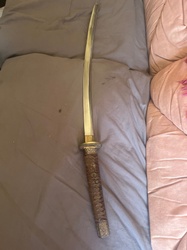
Inward curved, smaller knife with bone handle in hard leather sheath
These notes were written by the person who submitted this item. Appraiser.AI has not verified them, and the AI's identification and estimate may rely on them.
AI Estimated Value
Not an official valuation
$75 - $150
AI estimate as of December 16, 2025 · verify with a professional before acting
AI-Generated · Verify before acting
Everything on this page is generated by AI for informational purposes only. AI can make mistakes — the AI may misidentify items or misattribute them (artist, maker, brand, designer, origin, era). This is not an official valuation and should not be used for insurance, sale, tax, estate, legal, or lending purposes — or any decision requiring a certified appraisal. It is not an authoritative claim about any person, brand, or rights holder — do not share or rely on it as a factual statement about a third party. Always consult qualified professionals before making financial decisions.
This analysis also relies on unverified notes provided by the user, which may be incomplete or inaccurate and could affect the result.
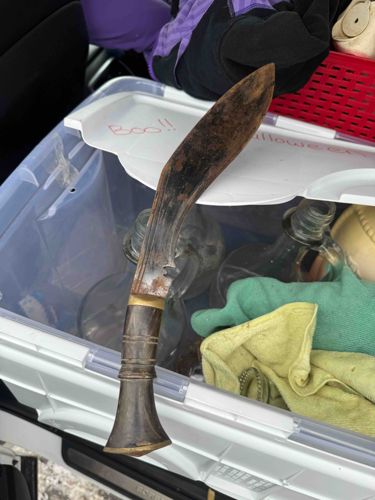
This item is an antique or vintage Kukri knife, a traditional Nepalese blade characterized by its distinct inward-curving shape. The blade, visible at the top, appears to be made of a ferrous metal, likely steel, and exhibits significant surface corrosion, rust, and pitting. Its dark, mottled brown and black coloration indicates a lack of recent maintenance and exposure to moisture. The characteristic 'cho' or notch at the base of the blade, intended to prevent blood from reaching the handle and to catch opposing blades, is visible. The handle, or hilt, appears to be crafted from wood, possibly buffalo horn, with a dark, rich brown tone, suggesting a natural material. It features a decorative brass or similar golden-htoned metal band or bolster where it meets the blade, and a flared, bell-shaped pommel also likely made of brass or a similar metal, securing the tang of the blade. The overall construction suggests a full-tang design, typical for such functional blades, although this is not directly visible. The condition of the knife points to considerable age and heavy use or neglect, rather than being a newly manufactured decorative piece. There are no clear manufacturer's marks or signatures visible, which is common for older, traditionally made Kukris. The craftsmanship, though showing wear, appears robust, indicative of a tool made for practical purposes. The provided context mentions a 'smaller knife with bone handle in hard leather sheath,' however, the visual evidence strongly suggests a wooden/horn handle, and the sheath is not present in the image. This discrepancy should be noted for further appraisal. The style aligns with traditional Nepalese Kukris, suggesting an origin from the Indian subcontinent, possibly from the late 19th to mid-20th century.
AI Appraisal Report
Upon examining the provided image of this Kukri knife, I assess it to be a vintage, likely late 19th to mid-20th century, example of a traditional Nepalese bladed tool. The blade, showing significant corrosion, rust, and pitting, suggests considerable age and lack of proper preservation. The dark, mottled surface is consistent with ferrous metal exposure to moisture over time. The presence of the 'cho' is a characteristic feature confirming its traditional design. The handle appears to be crafted from a dark wood or possibly horn, rather than bone as suggested in the additional details, which is a common material. The brass or similar golden-toned metal bolster and bell-shaped pommel are consistent with traditional Kukri construction. The overall condition indicates a functional tool rather than a decorative modern reproduction, albeit one that has seen heavy use or neglect.
Market conditions for such items vary. While antique Kukris have a dedicated collector base, the poor condition of this particular blade significantly impacts its value. Comparables in good to very good condition can fetch higher prices, but this one's extensive rust and pitting reduce its appeal to many. Demand for these pieces is generally steady among collectors of ethnographic weapons and militaria, but extreme rarity is not a factor unless specific provenance or maker's marks were present. Factors significantly impacting its value include the heavy corrosion, the absence of a sheath (which often adds value), and the lack of any clear identifying marks. Without physical examination, I cannot definitively confirm the handle material, the exact blade construction (full tang is assumed but not visible), or the extent of damage that might be hidden by surface rust. In-person inspection would allow for proper cleaning to reveal any hidden marks, assessment of structural integrity, and material analysis. Provenance documentation, if available, correlating it to a specific period, region, or notable owner, would also significantly enhance its authenticity and value.