AI estimate as of August 9, 2025 · verify with a professional before acting
AI-Generated · Verify before acting
Everything on this page is generated by AI for informational purposes only. AI can make mistakes — the AI may misidentify items or misattribute them (artist, maker, brand, designer, origin, era). This is not an official valuation and should not be used for insurance, sale, tax, estate, legal, or lending purposes — or any decision requiring a certified appraisal. It is not an authoritative claim about any person, brand, or rights holder — do not share or rely on it as a factual statement about a third party. Always consult qualified professionals before making financial decisions.
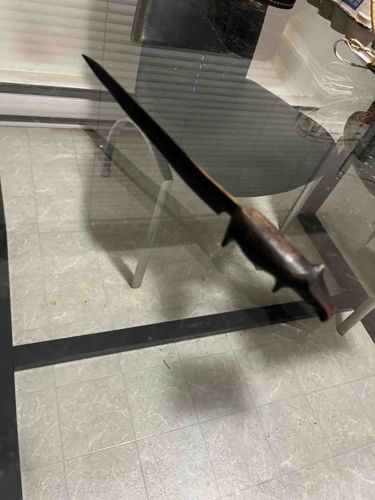
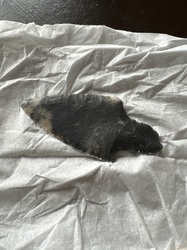
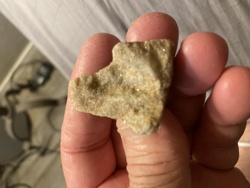
The item appears to be a vintage or antique dagger, possibly of Asian or tribal origin, given its distinctive hilt and blade shape. The blade is long and slender, with a dark, possibly blued or patinated finish, suggesting it is made of steel. It tapers to a sharp point, and the edges seem to be straight, indicating a utilitarian design. The hilt or handle is prominently featured and appears to be carved from a dark, possibly rainforest hardwood, exhibiting a rich, deep brown color. The carving on the hilt is intricate, featuring organic, almost skeletal or bone-like protrusions and ridges that are designed for grip. These elements suggest a hand-crafted quality rather than mass production. The overall form of the hilt is ergonomic, designed to fit comfortably in the hand. The connection between the blade and the hilt is not clearly visible, but it seems to be a sturdy, integrated construction. There are no visible maker's marks or signatures from the provided image. The condition of the item indicates significant age, with the blade showing a consistent dark patina and the wooden hilt displaying a smooth, worn surface consistent with handling. There are no obvious signs of major damage or repairs, such as cracks in the wood or bends in the blade, though subtle wear is evident, contributing to its aged aesthetic. The unique hilt carving makes this a distinctive piece, possibly used as a ceremonial item, a personal defense weapon, or a tool.
AI Appraisal Report
Upon visual examination of the provided image, this carved wood-hilted dagger presents as an intriguing piece, likely of vintage or antique origin. The dark, patinated steel blade suggests age and traditional craftsmanship, while the intricately carved hardwood hilt is the item's most distinguishing feature. The carving's organic, almost skeletal motif, coupled with the ergonomic design, points to a hand-crafted quality. The overall condition appears consistent with age and gentle handling, showing a smooth, worn surface on the wood and a consistent patina on the blade, with no obvious major damage or repairs visible. This suggests good preservation for its presumed age.
From the image alone, assessing authenticity with absolute certainty is challenging. The construction appears sturdy and integrated, indicating purposeful creation rather than decorative imitation. However, without a physical inspection, I cannot confirm the wood species, the true nature of the blade's metallurgy, or the exact age through material analysis. Market comparables for unique, tribal, or ethnic daggers with distinctive carved hilts vary widely based on origin, confirmed age, and historical significance. Demand for such unique pieces is niche but steady among collectors of ethnographic artifacts and weaponry. The rarity lies primarily in the specific design and potential origin rather than the materials themselves.
Key factors impacting value include the confirmed origin (e.g., specific tribe or region), exact age, and the quality of the carving. The absence of maker's marks, while not uncommon for such items, complicates precise attribution. To fully authenticate and confirm value, an in-person examination is crucial. This would allow for detailed inspection of construction, material analysis of both wood and blade (e.g., spectroscopy for blade composition, dendrochronology for wood if applicable), and a thorough search for hidden marks or traditional provenance indicators. Provenance documentation, if available, would significantly enhance its value by cementing its history and origin. Without these, the appraisal remains largely based on aesthetic appeal and presumed age.