These notes were written by the person who submitted this item. Appraiser.AI has not verified them, and the AI's identification and estimate may rely on them.
AI Estimated Value
Not an official valuation
$5 - $15
AI estimate as of November 10, 2025 · verify with a professional before acting
AI-Generated · Verify before acting
Everything on this page is generated by AI for informational purposes only. AI can make mistakes — the AI may misidentify items or misattribute them (artist, maker, brand, designer, origin, era). This is not an official valuation and should not be used for insurance, sale, tax, estate, legal, or lending purposes — or any decision requiring a certified appraisal. It is not an authoritative claim about any person, brand, or rights holder — do not share or rely on it as a factual statement about a third party. Always consult qualified professionals before making financial decisions.
This analysis also relies on unverified notes provided by the user, which may be incomplete or inaccurate and could affect the result.
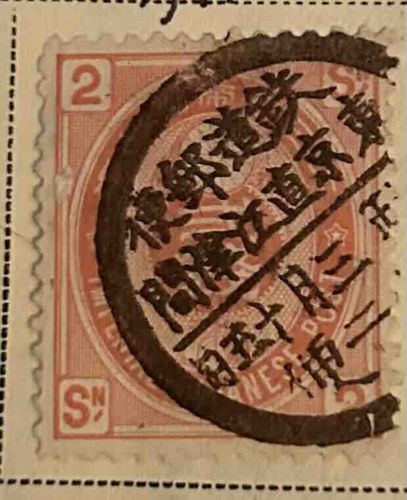
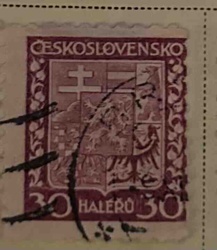
This is a rectangular, perforated postage stamp, likely from Japan, with a dominant reddish-orange hue. The stamp features a central design, partially obscured by a prominent circular cancellation mark. In the upper left corner, the numeral '2' is clearly visible, indicating its denomination. Below that, in the lower-left corner, are the letters 'S' and 'N', likely signifying 'Sen', a unit of Japanese currency. The cancellation mark is a heavy, dark, semi-circular postal cancellation, covering approximately two-thirds of the stamp's right side. This cancellation contains what appears to be Japanese or Chinese characters, along with a date stamp, though the full details are not clearly legible. The overall condition of the stamp shows signs of use, primarily the heavy cancellation mark, and some slight creasing or wear on the edges, consistent with a used postal item. The perforations around the edges appear relatively intact, though some might be flattened or slightly damaged from handling. The paper quality seems standard for a postage stamp of its era. This stamp likely dates from the late 19th or early 20th century, given the style and currency denomination, and common practices of the time. The craftsmanship appears to be of standard governmental printing quality, designed for mass production rather than artistic uniqueness.
AI Appraisal Report
Based on my visual examination of the provided image of the Used 2 Sen Japanese Postage Stamp, I assess its condition as fair to good used condition. The prominent circular cancellation mark covers a significant portion of the stamp, which is typical for a used postal item but generally reduces aesthetic appeal and value. Despite the heavy cancellation, the denomination '2 Sen' is clearly visible, aiding identification. The perforations appear intact, though minor wear on the edges is evident. Authenticity, based solely on the image, appears consistent with genuine Japanese postal issues of the late 19th or early 20th century. The style, currency, and printing quality align with stamps from that era, and there are no immediate red flags suggesting a counterfeit from visual inspection.
Regarding market conditions, used common Japanese stamps from this period typically have a modest value. The '2 Sen' denomination, while not exceptionally rare, isn't as abundant as some lower denominations. Comparables would include other similarly cancelled, common Japanese definitive stamps. Demand is generally moderate among philatelists specializing in Japanese or classic global stamps. The primary factor limiting the value of this specific stamp is the heavy cancellation, which obscures significant portions of the design. A lighter, neater cancellation, or an uncancelled (mint) example, would command a significantly higher price.
My valuation of $5 - $15 reflects its status as a common, heavily cancelled used stamp. For a full authentication and more precise valuation, a physical in-person examination would be crucial to assess paper type, watermarks (if any), printing method nuances, and gum condition (if unused). Microscopic examination could confirm printing details and rule out modern reproductions. Additionally, any provenance documentation would be beneficial, though unlikely for a stamp of this modest value.