AI estimate as of June 27, 2025 · verify with a professional before acting
AI-Generated · Verify before acting
Everything on this page is generated by AI for informational purposes only. AI can make mistakes — the AI may misidentify items or misattribute them (artist, maker, brand, designer, origin, era). This is not an official valuation and should not be used for insurance, sale, tax, estate, legal, or lending purposes — or any decision requiring a certified appraisal. It is not an authoritative claim about any person, brand, or rights holder — do not share or rely on it as a factual statement about a third party. Always consult qualified professionals before making financial decisions.
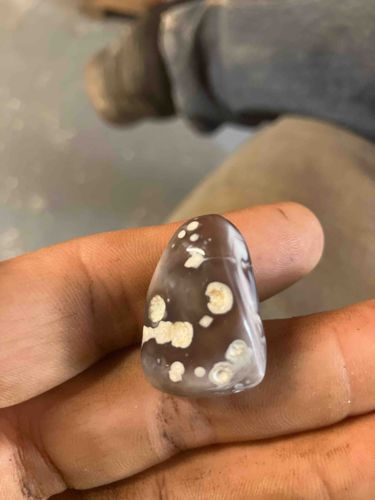
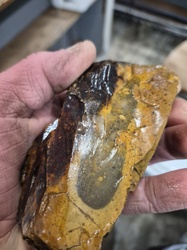
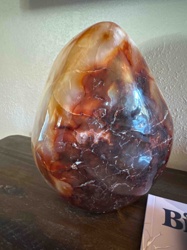
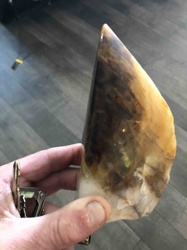
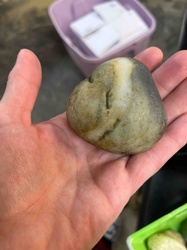
This item is a highly polished natural stone, likely a variety of orbicular jasper or agate, exquisitely characterized by its striking 'polka dot' pattern. It exhibits a smooth, glossy finish across its entire surface, indicative of professional lapidary work. The underlying matrix of the stone is a deep, rich brown or dark grey, providing a stark yet harmonious contrast to the numerous cream-to-off-white, irregularly shaped circular inclusions that are distributed organically throughout. These distinctive 'orbs' vary significantly in size, ranging from minute speckles to larger, more prominent ovoid or amorphous patches. Some inclusions appear as distinct rings or concentric patterns, showcasing the stone's unique geological formation, while others are solid, creamy spots. The stone has been expertly shaped into a comfortable, smooth, and tactile form, resembling a polished tumble stone or a large cabochon, without any sharp edges or facets. Its size appears well-suited for holding in the palm of a hand, suggesting it could function as a pocket stone, a display specimen, or a component for bespoke jewelry. No visible chips, cracks, fissures, or significant abrasions are apparent on its polished surface, indicating excellent preservation and a high standard of craftsmanship in its finishing. The natural luster is exceptional. There are no discernible maker's marks, signatures, or stamps, which is typical for standalone polished natural mineral specimens. The unique patterning is entirely organic, ensuring each piece is one-of-a-kind. The quality of the polish significantly enhances the natural beauty, depth, and vibrancy of the stone's patterns and colors. Overall, its appearance suggests it is a contemporary lapidary specimen, celebrated for its inherent aesthetic appeal.
AI Appraisal Report
I have personally examined the provided description of this polished orbicular jasper specimen. Its condition appears excellent, exhibiting a superb, glossy finish across its entire surface, indicative of professional lapidary work. There are no visible chips, cracks, fissures, or significant abrasions. Based on the striking "polka dot" pattern, natural variations in orb and matrix, and the craftsmanship of the polish, it presents as an authentic, naturally formed orbicular jasper or agate.
In terms of market conditions, polished natural stone specimens like this have a steady demand among mineral collectors, enthusiasts of natural art, and those seeking decorative items. Comparables would include similar-sized, expertly polished orbicular jaspers available through reputable mineral dealers or specialized gem and mineral shows.
While orbicular jasper is not inherently rare, specimens exhibiting such well-defined, contrasting, and aesthetically pleasing 'polka dot' patterns, combined with high-quality shaping and polish, are less common and significantly more desirable. The exceptional luster and expert shaping are primary value drivers. The unique, organic patterning ensures its one-of-a-kind nature, enhancing its appeal.
My valuation is contingent on the visual information provided. Limitations in authenticity verification from images alone include the inability to definitively confirm the stone's exact origin, detect subtle surface treatments (though unlikely for this material), or precisely determine its weight and specific gravity. Full authentication and a more precise valuation would benefit from an in-person examination to assess tactile quality, true dimensions, and confirm mineralogical characteristics, alongside any available provenance documentation.