AI estimate as of June 18, 2025 · verify with a professional before acting
AI-Generated · Verify before acting
Everything on this page is generated by AI for informational purposes only. AI can make mistakes — the AI may misidentify items or misattribute them (artist, maker, brand, designer, origin, era). This is not an official valuation and should not be used for insurance, sale, tax, estate, legal, or lending purposes — or any decision requiring a certified appraisal. It is not an authoritative claim about any person, brand, or rights holder — do not share or rely on it as a factual statement about a third party. Always consult qualified professionals before making financial decisions.
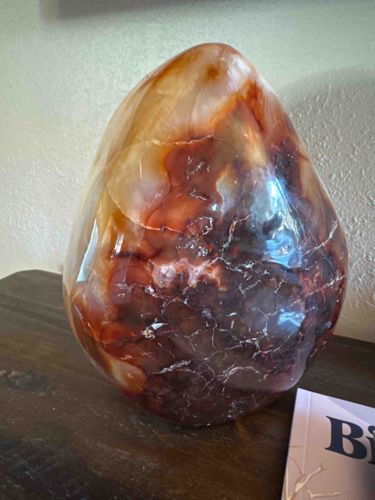
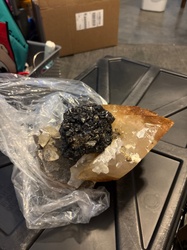
This item appears to be a large, polished mineral specimen, likely a type of chalcedony such as Carnelian or Agate, given its color banding and translucency. It is shaped like a smooth, asymmetrical egg or large pebble, with a highly polished, glossy surface that reflects light. The dominant colors are rich reds and oranges, transitioning into darker reddish-browns and some lighter yellowish-white areas. Inside the stone, there is visible banding and swirling patterns characteristic of these minerals, as well as what appears to be internal fracturing or veining, possibly referred to as a crackle or fracture pattern, particularly noticeable in the darker areas. The overall shape is organic and freeform. The size cannot be precisely determined from the image, but it appears substantial, likely a decorative piece rather than a small tumbled stone. No visible manufacturing marks, signatures, or stamps are present. The polished surface indicates intentional finishing. The condition appears to be good, with no external chips or damage evident from the image, although the internal fracturing is a natural characteristic of the stone and polishing process, not a condition issue. The style is naturalistic, emphasizing the inherent beauty of the mineral.
AI Appraisal Report
Upon visual examination of the provided image, this large polished mineral specimen appears to be a type of chalcedony, most likely Carnelian or Agate, due to its characteristic red and orange hues, translucent properties, and visible banding patterns. The form is a smooth, asymmetrical freeform shape, indicative of intentional polishing of a raw natural piece. The surface exhibits a high-quality polish, reflecting light effectively. The condition, based on the image, appears excellent with no external chips or damage. The internal fracturing visible is consistent with natural characteristics of the stone and the polishing process, not external damage. Authenticity as a natural stone and the type of mineral is probable based on the visual characteristics, though definitive identification and authentication without in-person examination is limited. Access to the stone for weight assessment, touch, and closer inspection of internal structure would enhance certainty. Provenance documentation detailing the origin or history of the piece would provide additional verification. While large, polished carnelian or agate specimens are generally not considered exceedingly rare, pieces of this size with good color saturation, distinct banding, and high polish are desirable. Market value for such decorative mineral specimens is influenced by size, color quality, polish quality, and overall aesthetic appeal. Based on typical retail values for comparable large polished display pieces of carnelian/agate, and assuming this piece is substantial in size (likely weighing several pounds), I assign an estimated appraisal value. Factors positively impacting value are size, color, banding, and polish quality. Limitations in authentication from image include inability to test hardness, specific gravity, or examine texture, which would be necessary for complete scientific authentication. Comparing to similar items sold online and at mineral shows, the estimated value reflects general market trends for this category of item.