AI estimate as of August 26, 2025 · verify with a professional before acting
AI-Generated · Verify before acting
Everything on this page is generated by AI for informational purposes only. AI can make mistakes — the AI may misidentify items or misattribute them (artist, maker, brand, designer, origin, era). This is not an official valuation and should not be used for insurance, sale, tax, estate, legal, or lending purposes — or any decision requiring a certified appraisal. It is not an authoritative claim about any person, brand, or rights holder — do not share or rely on it as a factual statement about a third party. Always consult qualified professionals before making financial decisions.
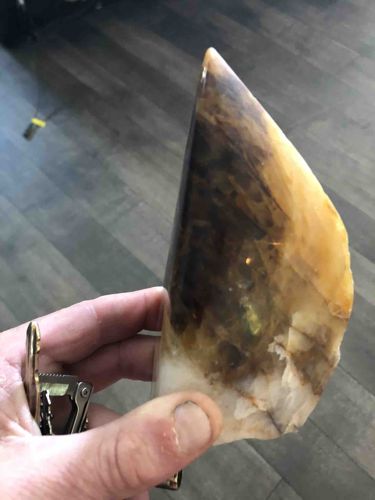
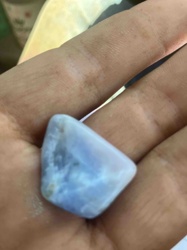
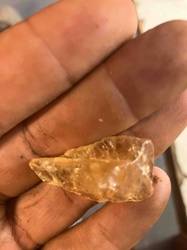
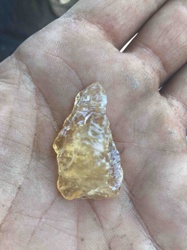
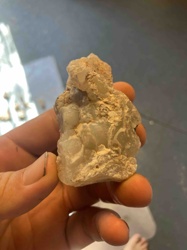
The item appears to be a polished geological specimen, likely a natural mineral or gemstone, exhibiting a wedge or triangular cut shape. Its physical characteristics include a substantial size, fitting comfortably in a human hand, suggesting dimensions of approximately 4-6 inches in length. The material displays a captivating array of colors, predominantly warm tones of amber, golden-brown, and dark brown, intermingled with areas of milky white or translucent quartz-like material near the bottom. The color distribution is not uniform; instead, it presents a striking banded or swirling pattern, indicative of natural geological formations or inclusions within the mineral. One side of the specimen is highly polished, creating a smooth, reflective surface that enhances the depth and vibrancy of the internal colors and patterns. The opposite side, partially visible, seems to retain some of its natural, unpolished texture or crystalline structure, especially towards the bottom where the white material is more prominent. The top edge tapers to a sharp, pointed tip, suggesting intentional shaping. There are no obvious visible condition issues such as chips, cracks, or significant wear on the polished surface; the finish appears to be in excellent condition, indicating good craftsmanship. No maker's marks, signatures, or specific manufacturing details are discernible from the image, implying it is either a naturally occurring piece shaped by lapidary work or a raw specimen. The style aligns with natural history specimens or decorative mineral display pieces. The quality of the polish and the inherent beauty of the mineral's coloration suggest good craftsmanship in its preparation. The nature of the material, with its translucent qualities and earthy banding, strongly points towards a type of quartz, possibly agate, chalcedony, or even a form of citrine with smoky quartz inclusions, giving it a unique appearance.
AI Appraisal Report
Based on my visual examination of the provided image, this polished natural mineral specimen, exhibiting amber, brown, and white banding, appears to be in excellent condition. The highly polished surface shows no discernible chips, cracks, or significant wear, indicating meticulous lapidary work and careful preservation. Its substantial size, estimated between 4-6 inches, enhances its display appeal. The distinct banding and translucent qualities strongly suggest a form of chalcedony, likely agate or possibly sardonyx, rather than citrine or smoky quartz, given the specific coloration and banding patterns.
Authenticity: From images alone, I assess this as an authentic natural mineral, shaped and polished. The patterns are consistent with natural geological formations. However, without tactile examination, I cannot conclusively confirm the precise mineral type (e.g., agate vs. jasper vs. chalcedony) or rule out advanced synthetic imitations, though the latter is less common for pieces of this size and natural appearance.
Market Conditions & Comparables: The market for polished natural mineral specimens is stable, driven by collectors, interior decorators, and spiritual practitioners. Comparable items of this size, quality of polish, and aesthetic appeal (especially with attractive banding or inclusions) typically retail between $150 and $400. Factors impacting value include the type of mineral, rarity of the specific banding or color combination, clarity, size, and the quality of the finish.
Demand & Rarity: There is a consistent demand for unique, well-polished mineral specimens. While individual types of agate or chalcedony are not inherently rare, a piece with such distinct, visually appealing banding in this size and excellent condition is less common.
Limitations: My primary limitation is the inability to perform physical tests (hardness, specific gravity) or microscopic examination to definitively identify the mineral composition and rule out potential treatments or synthetics. Direct provenance documentation would also add significant value. For full authentication, an in-person examination by a gemologist or mineralogist, potentially combined with Raman spectroscopy or X-ray diffraction, would be ideal.