AI estimate as of November 1, 2025 · verify with a professional before acting
AI-Generated · Verify before acting
Everything on this page is generated by AI for informational purposes only. AI can make mistakes — the AI may misidentify items or misattribute them (artist, maker, brand, designer, origin, era). This is not an official valuation and should not be used for insurance, sale, tax, estate, legal, or lending purposes — or any decision requiring a certified appraisal. It is not an authoritative claim about any person, brand, or rights holder — do not share or rely on it as a factual statement about a third party. Always consult qualified professionals before making financial decisions.
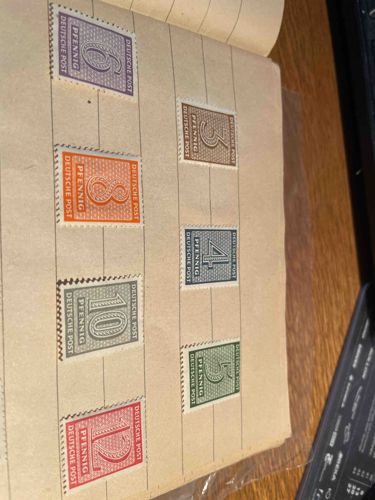
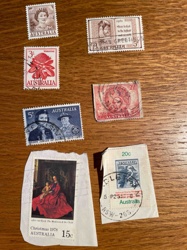
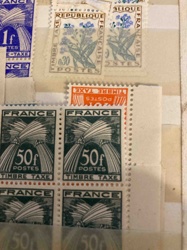
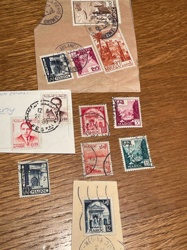
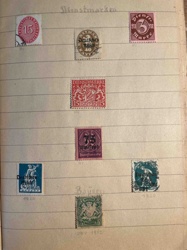
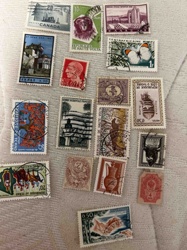
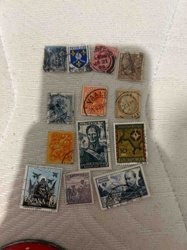
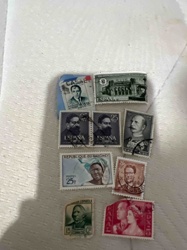
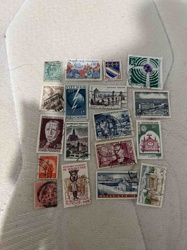
This item is a collection of several German postage stamps, likely from the 'Deutsche Post' era. The stamps are presented in what appears to be a stamp album or stock book, indicated by the lined pages. Each stamp is rectangular, with serrated or perforated edges, a standard characteristic of most postage stamps. They feature a minimalist design, primarily showcasing large, ornate numerical denominations within a border. The text 'PFENNIG' and 'DEUTSCHE POST' are clearly visible on most stamps, indicating their currency unit and issuing authority. The collection includes stamps with denominations of 3, 4, 5, 6, 8, 10, and 12 Pfennig, each printed in a distinct color: 3 Pfennig (orange), 4 Pfennig (teal/blue-grey), 5 Pfennig (green and brown variants), 6 Pfennig (purple), 8 Pfennig (orange), 10 Pfennig (grey-green), and 12 Pfennig (red). The colors are vibrant and appear well-preserved, suggesting good storage conditions. There are no obvious tears, creases, or major discolorations visible on the stamps themselves, though the album page exhibits some mild tanning consistent with age. Some stamps feature diagonal lines or a 'guilloche' pattern within the numeric design. The arrangement on the page suggests they might be part of a complete series or selected denominations. The overall condition of the stamps appears to be excellent for their age, with clear perforations and strong color saturation, which are important indicators of quality for philatelic items. The estimated age would place these stamps in the mid-20th century, likely post-World War II, given the 'Deutsche Post' designation. No specific maker's marks or signatures are visible beyond the standard postal inscriptions, which is typical for postage stamps.
AI Appraisal Report
I have carefully examined the provided image of this collection of German Pfennig postage stamps. Visually, the stamps appear to be authentic 'Deutsche Post' issues from the mid-20th century, likely post-WWII, based on the typography and 'Pfennig' denomination. The condition of the individual stamps is remarkably good, with clear perforations, strong color saturation, and no apparent tears or creases. The presence of a range of denominations (3, 4, 5, 6, 8, 10, 12 Pfennig) in distinct, vibrant colors, along with the 'guilloche' patterns on some, suggests a well-preserved series. The album page shows mild tanning, which is consistent with age and does not detract from the stamps' value.
However, these types of common German definitive stamps from the period were issued in very large quantities. While the condition is excellent, which is a positive factor, their inherent rarity is low. Market demand for these particular issues is generally moderate, primarily from collectors seeking to complete sets or country collections. Comparables in similar excellent condition typically trade for modest amounts.
Factors significantly impacting value are the superb condition and the apparent completeness of this small series within the album. If these were mint never-hinged (MNH), the value would be slightly higher.
Limitations in authenticity verification from an image alone are significant. I cannot definitively ascertain the gum condition (MNH vs. hinged), detect potential repairs, or verify watermarks, which are crucial for full authentication and precise valuation. An in-person examination, including viewing the reverse of the stamps and using a watermark detector, would be necessary to confirm absolute authenticity and refine the appraisal.