Photo and notes provided by the user — not generated by AI
Submitted photo · June 16, 2026
User's notes
No additional notes provided.
AI analysis below
AI appraisal
AI analysis & estimate
AI-Generated · Verify before acting
Everything below is generated by AI for informational purposes only. AI can make mistakes — the AI may misidentify items or misattribute them (artist, maker, brand, designer, origin, era). This is not an official valuation and should not be used for insurance, sale, tax, estate, legal, or lending purposes — or any decision requiring a certified appraisal. It is not an authoritative claim about any person, brand, or rights holder — do not share or rely on it as a factual statement about a third party. Always consult qualified professionals before making financial decisions.
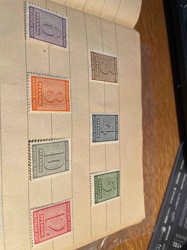
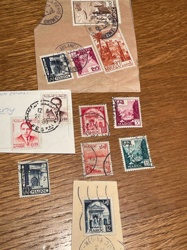
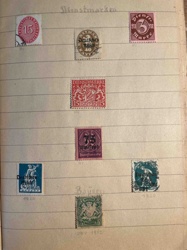
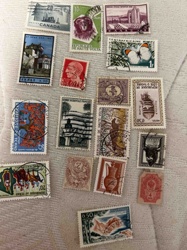
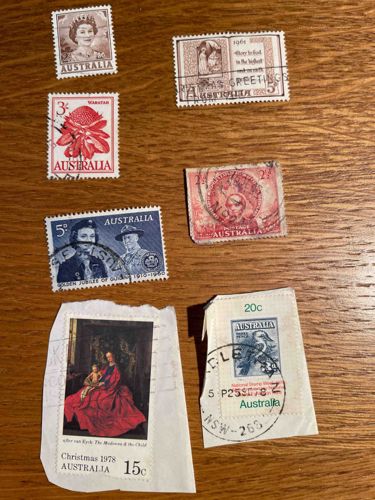
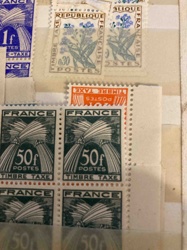
This is a collection of seven Australian postal stamps, depicting a variety of themes and periods, laid out on a wooden surface. The stamps vary in size, age, and condition, offering a glimpse into Australian philatelic history.
Starting from the top left, a sepia-toned stamp features a portrait bust of Queen Elizabeth II in a tiara, with 'AUSTRALIA' at the bottom and '2d' (two pence) likely implied though not clearly visible, indicating an earlier imperial era stamp. Below it is a vibrant red stamp depicting a 'WARATAH', a native Australian flower, with '3d' in the top left corner and 'AUSTRALIA' at the bottom. To the right of the Queen Elizabeth stamp, there is a brown-toned Christmas-themed stamp from '1961', featuring the text 'Glory to God in the highest and on earth.' and 'AUSTRALIA' at the bottom, alongside artwork depicting what appears to be an angel. Below this, another red-toned stamp, significantly worn and bearing a clear circular postmark dated '26 FEB 5-PM' (partially obscured), shows an early portrait, possibly of a monarch, with 'AUSTRALIA' at the bottom, and appears to be a '2d' denomination. Its ragged edges and heavy cancellation suggest it was used.
The bottom row includes three stamps. On the left, a larger stamp with a cream-colored border, depicts a classical painting titled 'after van Eyck The Madonna & the Child'. It's a 'Christmas 1978' issue, valued at '15c' (15 cents), with 'AUSTRALIA' at the bottom. This stamp is still affixed to a larger piece of envelope or postal paper, indicating it was likely cut from a piece of mail. To its right, partially obscured but visible, is a blue-toned stamp showing two figures in uniform, with 'AUSTRALIA' and '5c' (5 cents) visible, alongside text 'GOLDEN JUBILEE OF GALLIPOLI 1915-1965', suggesting it commemorates fifty years since Gallipoli. The final stamp on the far right, also affixed to a piece of postal paper, is a '20c' stamp featuring a kookaburra against a blue and green background with 'AUSTRALIA'. It bears a circular postmark that reads 'S.C.L.E. 5 P25578 NSW-265' and 'Australia', indicating it was cancelled in New South Wales. The variation in denominations (pence vs. cents) points to different periods of issue, with pence stamps predating Australian decimalization in 1966. The condition of the stamps ranges from relatively crisp and clean (Waratah, Elizabeth II) to heavily used and postmarked (red 2d, Kookaburra) or still attached to postal fragments (Madonna, Kookaburra), suggesting a mixed collection from a casual accumulation rather than a curated set. The edges on some stamps are slightly torn or creased. The color saturation on several stamps remains good, despite some fading on the older, more used examples.
AI Appraisal Report
·AI can make mistakes·Verify before acting
I have examined the collection of seven Australian postal stamps presented. This is a very casual accumulation rather than a curated set. The stamps exhibit a wide range of conditions, from relatively crisp to heavily used with significant wear, postmarks, and even attached to fragments of postal paper. This suggests they were salvaged from mail rather than carefully preserved. The denominations span both pence and cents, indicating a timeline from pre-1966 decimalization to at least the late 1970s. The mixed condition, lack of uniformity, and the fact that several are cut from envelopes significantly impact their value for serious collectors. While some designs are appealing (e.g., Waratah, Kookaburra), none appear to be rare issues or particularly sought-after varieties. The common themes and apparent heavy usage mean demand and rarity are low. Market conditions for such mixed, used collections are generally weak, appealing mostly to beginner collectors or those seeking illustrative examples for general interest rather than philatelic investment. Given the visible condition and common nature of these stamps, I estimate their current market value to be minimal.
My assessment of authenticity is based purely on visual examination of the images provided. The stamps appear to be genuine issues from Australia Post; however, without physical inspection, I cannot confirm the absence of counterfeits, reprints, or modifications. An in-person examination would allow for tactile inspection, detailed scrutiny under magnification for printing anomalies, watermarks (if applicable), paper type, and gum condition (if unused), which are all crucial for full authentication and accurate valuation. Provenance documentation, though unlikely for such a common collection, would further confirm their history. Limitations due to image-only examination prevent me from definitively ruling out issues like hidden tears, thins, repairs, or re-gumming.