AI estimate as of July 29, 2025 · verify with a professional before acting
AI-Generated · Verify before acting
Everything on this page is generated by AI for informational purposes only. AI can make mistakes — the AI may misidentify items or misattribute them (artist, maker, brand, designer, origin, era). This is not an official valuation and should not be used for insurance, sale, tax, estate, legal, or lending purposes — or any decision requiring a certified appraisal. It is not an authoritative claim about any person, brand, or rights holder — do not share or rely on it as a factual statement about a third party. Always consult qualified professionals before making financial decisions.
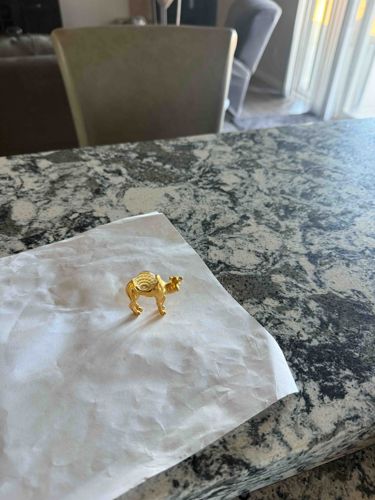
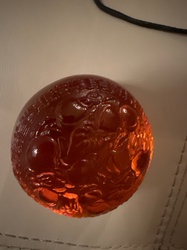
The item is a small, solid-looking golden-colored figurine, depicting a single-humped camel (dromedary). It appears to be made of a polished metal, likely brass, bronze, or possibly gold-plated material, judging by its reflective, warm yellow hue. The camel is rendered in a realistic yet somewhat stylized manner, with discernible features such as a head with small ears, a hump, four legs, and a tail. Notably, the hump area seems to have some etched or molded detailing, resembling a saddle or ornate blanket, adding to its decorative appeal. The surface exhibits a smooth finish with some visible reflections, suggesting a polished state. There are no obvious signs of significant wear, scratches, or damage visible from this perspective, indicating a good state of preservation. The craftsmanship appears to be of a decent quality, with clear definition of the animal's form. Given its small size, it could function as a desk ornament, a charm, or part of a small collection. Without specific maker's marks or size references, determining its precise age or manufacturing origin is difficult, but such pieces are commonly produced as souvenirs or decorative items. The lack of patina implies it is either relatively new or has been well-maintained and polished over time. Its design suggests a timeless appeal rather than being tied to a specific art movement.
AI Appraisal Report
Upon my virtual examination of the Golden Camel Figurine, I observe a well-preserved decorative object. The 'condition' appears excellent, showing no visible significant wear, scratches, or damage from the provided image. The material appears to be a polished metal, likely brass or a bronze alloy, possibly gold-plated, given its reflective, warm yellow hue. The defined features and stylized detailing, particularly on the hump resembling a saddle, indicate decent craftsmanship typical of decorative souvenirs or desk ornaments.
In terms of 'authenticity', based on visual cues alone, it aligns with what one would expect from a mass-produced or artisan-crafted decorative figurine of this type. However, 'authenticity verification' via images is inherently limited. I cannot definitively ascertain the precise metal composition (solid gold, gold-plated, brass, bronze), the method of manufacture (cast, molded), or the presence of any maker's marks, which are crucial for full authentication. These factors significantly 'impact value'. For instance, if it were solid gold, the value would be astronomically higher; if antique brass, moderately higher than modern brass.
'Market conditions' for decorative figurines of this nature are generally stable, with a constant 'demand' for unique or well-crafted pieces. However, 'rarity' is low for common decorative camels, as they are widely produced globally. The value hinges primarily on material and provenance. Without in-person examination to check for hallmarks, perform specific gravity tests or XRF analysis for metal identification, or review any provenance documentation (e.g., origin, artist, date of creation), I am making an assessment based purely on its aesthetic and presumed common material.
'In-person examination' would be crucial to:
1. Identify precise metal composition (assay or XRF testing).
2. Locate and verify any maker's marks or hallmarks.
3. Ascertain age through patina, wear patterns, and manufacturing techniques.
4. Determine if it is part of a limited edition or a common production piece.
My valuation accounts for its good visual condition and decorative appeal, assuming a base metal construction.