These notes were written by the person who submitted this item. Appraiser.AI has not verified them, and the AI's identification and estimate may rely on them.
AI Estimated Value
Not an official valuation
$10-25
AI estimate as of August 18, 2025 · verify with a professional before acting
AI-Generated · Verify before acting
Everything on this page is generated by AI for informational purposes only. AI can make mistakes — the AI may misidentify items or misattribute them (artist, maker, brand, designer, origin, era). This is not an official valuation and should not be used for insurance, sale, tax, estate, legal, or lending purposes — or any decision requiring a certified appraisal. It is not an authoritative claim about any person, brand, or rights holder — do not share or rely on it as a factual statement about a third party. Always consult qualified professionals before making financial decisions.
This analysis also relies on unverified notes provided by the user, which may be incomplete or inaccurate and could affect the result.
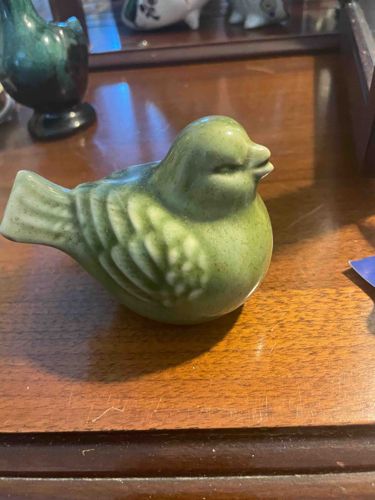
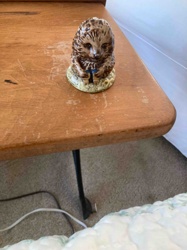
This item is a small, solid ceramic or porcelain figurine depicting a stylized bird. The primary color is a mottled sage green with variations in shade, suggesting a reactive glaze or intentional uneven application to create depth and a somewhat rustic or naturalistic appearance. The bird is rendered with a plump, rounded body, a short tail with feathering indicated by shallow, incised lines, and distinct wings, also delineated by similar incised lines or molded relief that suggest individual feathers. The head is relatively compact with a small, pointed beak and simple, possibly unpainted or very subtly sculpted eyes that are not distinctly visible in the provided image. The surface has a glossy finish, indicative of a glaze. There are no readily apparent cracks, chips, or significant damage, suggesting it is in good, used condition. The overall craftsmanship appears to be factory-made, with a uniform and mass-produced feel, rather than hand-sculpted artisan work. It likely dates from the mid to late 20th century, a common period for such ceramic decorative items. The base is not visible, so identifying any maker's marks or signatures is not possible. The piece's quality is typical of decorative figurines intended for home display, emphasizing aesthetic appeal over intricate detail or fine art value. Its small size makes it suitable for shelf or desk decoration.
AI Appraisal Report
Upon examining the provided image and description of the green ceramic bird figurine, I can offer the following appraisal. The item appears to be in good, used condition with no visible cracks, chips, or significant damage. The glossy finish and uniform appearance suggest it is a factory-made piece, likely mass-produced. Its style, particularly the mottled sage green glaze and stylized form, points to a mid-to-late 20th-century origin, fitting within common decorative trends of that era. Authenticity, in terms of it being a ceramic bird figurine, is evident from the visual information. However, without a physical examination, I cannot definitively assess minute surface imperfections, true tactile quality, or confirm the presence (or absence) and nature of any maker's marks on the base, which are crucial for full authentication regarding specific manufacturers or designers.
Market conditions for such decorative ceramic figurines are generally modest. These items are common on secondary markets, often found at estate sales, antique malls, and online platforms. Comparables would include similar mass-produced ceramic animal or bird figurines from the mid-20th century. Demand is present, but not high, primarily from collectors of vintage decor or those seeking accent pieces for their homes. Rarity is low; items of this type were produced in large quantities. Factors significantly impacting value are primarily its decorative appeal, condition, and lack of unique identifying marks or artisan craftsmanship. Had there been a renowned maker's mark or evidence of skilled hand-sculpting, the value would be considerably higher. Without in-person examination, providence documentation, or scientific testing of the clay or glaze composition, it’s impossible to confirm specific origins beyond the general time period or attribute it to a specific, potentially valuable, ceramic studio. The value reflects its nature as a common, decorative ceramic piece.