AI estimate as of August 26, 2025 · verify with a professional before acting
AI-Generated · Verify before acting
Everything on this page is generated by AI for informational purposes only. AI can make mistakes — the AI may misidentify items or misattribute them (artist, maker, brand, designer, origin, era). This is not an official valuation and should not be used for insurance, sale, tax, estate, legal, or lending purposes — or any decision requiring a certified appraisal. It is not an authoritative claim about any person, brand, or rights holder — do not share or rely on it as a factual statement about a third party. Always consult qualified professionals before making financial decisions.
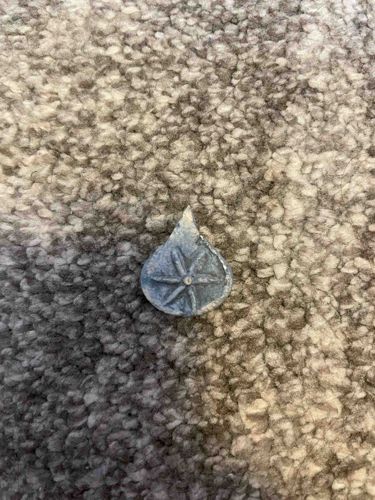
This item appears to be a small, hand-crafted decorative object, possibly made from a lightweight material such as clay, plaster, or perhaps a resin, given its matte finish and slightly irregular shape. Its overall form is that of a teardrop or a stylized flame, tapering to a point at the top and broadening at the base. The color is a muted, cool grey or light blue, suggesting either a natural tone of the material or a pastel wash. The most prominent feature is a six-pointed star or asterisk design embossed or carved into its surface. This star has a central circular depression, and each point extends outwards with a slightly raised, curved segment. The lines forming the star are not perfectly uniform, indicating a handmade quality. The edges of the object show some slight imperfections and a somewhat rough texture, consistent with a non-mass-produced item. There are no obvious signs of significant damage like chips or cracks, but the surface exhibits a subtle texture that might be intentional or a result of the material and crafting process. The item's small size, likely a few inches in height, makes it suitable as a charm, a miniature decorative accent, or a component of a larger craft project. No maker's marks or signatures are visible. Its style suggests a contemporary craft aesthetic, potentially dating from the late 20th or early 21st century.
AI Appraisal Report
Upon visual examination of the provided image, this teardrop-shaped decorative object appears to be a charming, hand-crafted item. Its matte finish and slightly irregular shape suggest it is made from a lightweight material such as clay, plaster, or resin, consistent with contemporary craft pieces. The muted grey/light blue color adds to its aesthetic appeal. The six-pointed star design, with its subtly raised and imperfect lines, reinforces the handmade quality. I note no significant damage like chips or cracks; the textured surface seems inherent to the material and crafting process, indicating good overall condition for a handmade item.
Authenticity, based solely on visual inspection of an image, is limited. While it presents as a genuine craft piece, a physical examination would be necessary to confirm the material composition, verify the manufacturing process (e.g., hand-sculpted vs. cast), and check for any hidden imperfections or repairs. Provenance documentation, though unlikely for such an item, could provide definitive authentication regarding its maker or origin. Scientific testing for material analysis would be an extreme measure, not justified for an item of this type unless specific doubts arose.
Market conditions for small, handmade decorative objects are generally stable, driven by aesthetic appeal and artisanal craftsmanship rather than intrinsic material value or historical significance. Comparables would include similar small craft items sold at artisan markets, online craft platforms (e.g., Etsy), or independent gift shops. Demand skews towards those seeking unique, non-mass-produced decor items. Rarity is low, as similar items are continuously produced by crafters.
Factors significantly impacting value include its handmade nature, good apparent condition, and aesthetic appeal. However, the lack of a known artist, signature, or historical context limits its value to the decorative rather than collectible sphere. Without any distinguishing characteristics like rare materials or significant age, its value is primarily as a decorative accent rather than a fine art or antique piece.