AI Appraisal Estimate

AI-generated estimates · not official valuations

From the user

What was submitted

Photo and notes provided by the user — not generated by AI

Submitted item photo
Submitted photo · May 27, 2026

User's notes

No additional notes provided.

AI analysis below

AI appraisal

AI analysis & estimate

AI-Generated · Verify before acting

Everything below is generated by AI for informational purposes only. AI can make mistakes — the AI may misidentify items or misattribute them (artist, maker, brand, designer, origin, era). This is not an official valuation and should not be used for insurance, sale, tax, estate, legal, or lending purposes — or any decision requiring a certified appraisal. It is not an authoritative claim about any person, brand, or rights holder — do not share or rely on it as a factual statement about a third party. Always consult qualified professionals before making financial decisions.

Read the full disclaimer

AI Identification

·Not independently authenticated·Verify before acting

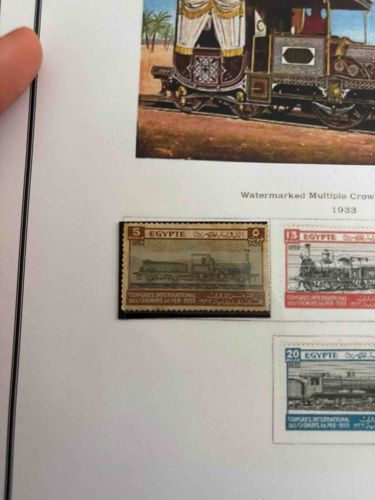
1933 Egyptian 5 Milliemes International Railway Congress Stamp

Philately / Postage Stamps

AI Estimated Value

·Not an official valuation·Verify before acting

$10.00 - $15.00

As of May 27, 2026

AI Item Analysis

·AI can make mistakes·Verify before acting
This is a philatelic specimen from Egypt, specifically the 5 milliemes denomination issued in 1933 to commemorate the XII International Railway Congress held in Cairo. The stamp features a bi-color design with a brown frame and a grey-black central vignette depicting an early steam locomotive, specifically Robert Stephenson's 1852 'No. 1' engine. The stamp is printed on paper and measures approximately 40mm x 24mm. The perfoations appear intact, though it is currently housed in a black protective mounting sleeve within a printed collection album. The top of the stamp bears the text 'EGYPTE' and the Arabic equivalent, while the bottom contains 'CONGRES INTERNATIONAL DES CHEMINS DE FER - 1933' in both French and Arabic. The denominations '5 MILLS' and the Arabic numeral '5' are situated in the upper corners. The condition of the stamp appears to be 'hingeless' or 'mounted' within an album, suggesting it is likely in Mint Never Hinged (MNH) or Mint Lightly Hinged (MLH) state, as no cancellation marks are visible. The colors are well-preserved with no significant fading. This issue is part of a four-stamp set (also including 13m, 15m, and 20m values) which is highly collected by both Egyptian postal history enthusiasts and topical train collectors. The high-quality intaglio printing reflects the craftsmanship of the Survey of Egypt printing works during the King Fuad I era.

AI Appraisal Report

·AI can make mistakes·Verify before acting
I have conducted a visual examination of the 1933 Egyptian 5 Milliemes International Railway Congress stamp. This specimen commemorates the XII International Railway Congress in Cairo and features the iconic Stephenson 'No. 1' locomotive. Based on the digital imagery, the stamp displays vibrant bi-color registration (brown and grey-black) with sharp intaglio detail characteristic of the Survey of Egypt's high-quality production under King Fuad I. The perforations appear consistent with the standard 13.5 gauge, and the margins are well-centered. No cancellation marks are present, suggesting a 'Mint' state. However, being housed in a black mount within an album typically indicates it has been previously hinged (MLH), though it could be Never Hinged (MNH); this distinction is the primary driver of value for this specific issue. The market for Egyptian philately remains robust, particularly for the 'Kingdom' era. While this 5m denomination is the lowest value in the four-stamp set, it remains highly desirable for topical 'Trains on Stamps' collectors. Comparables for a single 5m value in high-grade mint condition typically fetch between $10 and $15, whereas the complete set of four often commands $60 to $80. Critically, this appraisal is based on photographic evidence. I cannot verify the integrity of the gum or check for 'gum foxing' or thinning without a physical inspection. A definitive authentication would require a back-side examination to confirm the absence of hinges or 'sweating' and a watermarking test to ensure its genuineness. For high-value transactions, a certificate of authenticity from a recognized philatelic society is recommended to verify the original gum status.

Get your items appraised

Instant estimates of your treasures with AI-powered appraisals

Browse More Appraisals