AI Appraisal Estimate

AI-generated estimates · not official valuations

From the user

What was submitted

Photo and notes provided by the user — not generated by AI

Submitted item photo
Submitted photo · June 6, 2026

User's notes

No additional notes provided.

AI analysis below

AI appraisal

AI analysis & estimate

AI-Generated · Verify before acting

Everything below is generated by AI for informational purposes only. AI can make mistakes — the AI may misidentify items or misattribute them (artist, maker, brand, designer, origin, era). This is not an official valuation and should not be used for insurance, sale, tax, estate, legal, or lending purposes — or any decision requiring a certified appraisal. It is not an authoritative claim about any person, brand, or rights holder — do not share or rely on it as a factual statement about a third party. Always consult qualified professionals before making financial decisions.

Read the full disclaimer

AI Identification

·Not independently authenticated·Verify before acting

Assorted International Philatelic Postage Stamp Collection

Philately / Postage Stamps

AI Estimated Value

·Not an official valuation·Verify before acting

$15.00-$25.00

As of June 6, 2026

AI Item Analysis

·AI can make mistakes·Verify before acting
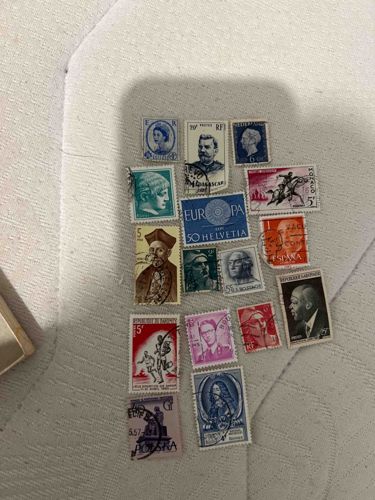
This is a diverse grouping of approximately sixteen international postage stamps, primarily dating from the mid-20th century. The collection features a variety of paper stocks and printing techniques, including lithography and photogravure across various sizes and orientations. Notable specimens include a blue 'EUROPA CEPT' 50c Helvetia (Switzerland) stamp, several African colonial-era stamps such as a Madagascar issue featuring a portrait and a Dahomey (now Benin) athletic commemorative, and European issues from the Netherlands, Spain, Monaco, and Poland. The color palette spans vibrant reds, deep blues, and sepia tones. Physical condition varies significantly across the grouping. Several stamps show heavy circular date stamp (CDS) cancellations in black ink, indicating they have been postally used. Performance regarding 'perforations' appears mixed; some edges are crisp while others show irregular tearing or 'short perfs.' There are visible signs of corner creasing on the larger vertical Madagascar stamp and slight surface foxing on some of the lighter-colored issues. The presence of paper remnants on the reverse of some (though not clearly visible) is suggested by the way they lay, indicating they may have been 'soaked' from envelopes. The age range likely spans from the 1940s through the late 1960s based on the 'Europa' and Dahomey designs. The collection represents common to mid-range circulation pieces rather than rare philatelic errors, but displays a broad historical and geographical range.

AI Appraisal Report

·AI can make mistakes·Verify before acting
My examination of this sixteen-stamp international grouping reveals a representative set of mid-20th-century postal history. The collection consists of common definitive and commemorative issues from Switzerland (Helvetia), former French colonies like Madagascar and Dahomey, and several European nations. Based on a visual inspection of the printing and cancellation marks, these appear to be genuine postally used specimens. The condition is characteristic of 'kiloware' or bulk-sorted stamps, with visible faults including blunt perforations, corner creases (notably on the Madagascar issue), and heavy cancellations that obscure central designs. The market for mid-century philatelic material is currently saturated with such common issues. Individual values for these specific stamps, such as the 1960s Europa CEPT or the Dahomey athletic commemoratives, typically range from $0.10 to $2.00 each in the secondary market. This collection's value is derived from its educational and geographic variety rather than rarity or philatelic scarcity. Limitations of this appraisal include the inability to inspect the reverses ('gum side') for 'hinge marks,' thins, or moisture damage, which are critical to valuation. Authentication of specific watermarks or paper variations—which can occasionally distinguish a common stamp from a rare variant—cannot be performed via images alone. For a definitive valuation, an in-person examination using a watermark fluid tray, perforation gauge, and high-magnification microscope is required to rule out modern reprints or to identify high-value sub-varieties.

Get your items appraised

Instant estimates of your treasures with AI-powered appraisals

Browse More Appraisals