AI Appraisal Estimate

AI-generated estimates · not official valuations

From the user

What was submitted

Photo and notes provided by the user — not generated by AI

Submitted item photo
Submitted photo · June 30, 2026

User's notes

No additional notes provided.

AI analysis below

AI appraisal

AI analysis & estimate

AI-Generated · Verify before acting

Everything below is generated by AI for informational purposes only. AI can make mistakes — the AI may misidentify items or misattribute them (artist, maker, brand, designer, origin, era). This is not an official valuation and should not be used for insurance, sale, tax, estate, legal, or lending purposes — or any decision requiring a certified appraisal. It is not an authoritative claim about any person, brand, or rights holder — do not share or rely on it as a factual statement about a third party. Always consult qualified professionals before making financial decisions.

Read the full disclaimer

AI Identification

·Not independently authenticated·Verify before acting

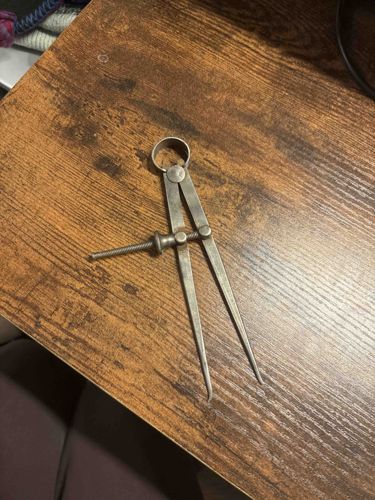
Spring Divider Calipers

Measuring Instrument

AI Estimated Value

·Not an official valuation·Verify before acting

$30-$50

As of June 30, 2026

AI Item Analysis

·AI can make mistakes·Verify before acting
The item is a pair of vintage spring divider calipers, crafted from what appears to be steel or a similar metal alloy, exhibiting a natural, aged patina with a dull, silvery-grey finish. The construction consists of two pointed legs joined at the top by a pivot point and an adjustable screw mechanism. At the very top, encircling the pivot, is a sturdy ring, likely for hanging or storage. The main body of the calipers features two solid, tapering legs, each terminating in a sharp point, characteristic of dividers used for scribing circles, arcs, or transferring measurements. A key distinguishing feature is the adjustable screw mechanism located approximately one-third of the way down from the pivot. This mechanism comprises a threaded rod passing through the legs, with a knurled nut for fine adjustment of the distance between the points. The knurling on the nut appears to be in good condition, suggesting functionality. The legs themselves show some wear consistent with age and use, including minor surface scratches and possibly some discoloration from oxidation, contributing to its vintage aesthetic. The overall design is utilitarian and robust, indicating it was built for precision and durability in tasks such as woodworking, metalworking, or drafting. There are no obvious signs of significant damage such as bends or breaks, suggesting it remains in functional condition. Its design suggests a period from the late 19th to mid-20th century, a common style for such precision tools.
AI Appraisal Report

·AI can make mistakes·Verify before acting
Based on my visual examination of the provided image, this pair of vintage spring divider calipers appears to be in good, functional condition. The steel or similar metal alloy construction, combined with the aged patina, indicates authenticity as a period tool, likely from the late 19th to mid-20th century. I observe minor surface wear and discoloration consistent with age and use, but no significant damage like bends or breaks, suggesting it remains robust and accurate for its intended purpose. The adjustable screw mechanism with a knurled nut appears intact and functional. Market conditions for such utilitarian vintage measuring instruments are generally stable but not exceptionally strong. While there's a steady demand from collectors, woodworkers, metalworkers, and drafting enthusiasts, these tools are not rare. Numerous similar examples can be found across various online platforms and antique markets. Comparables typically range from $20 to $70 depending on condition, size, and specific maker's marks (if present and identifiable). Key factors impacting value here are its good preservation and apparent functionality. However, it lacks any unique identifying marks, historical significance, or exceptional craftsmanship that would elevate its value beyond the typical market range for common vintage tools. The demand is moderate, driven by utility and nostalgic appeal rather than rarity. It is crucial to note the limitations of this appraisal due to visual examination alone. A full in-person examination would be necessary to confirm the exact material composition, assess the smoothness and precision of the screw mechanism, and check for any subtle structural integrity issues or hidden repairs. While the authenticity as a vintage tool is strongly suggested by its appearance, definitively ruling out modern reproductions with an aged finish would require hands-on inspection or potentially material testing. Provenance documentation, though unlikely for an item of this type, would provide additional historical context and could enhance value.

Get your items appraised

Instant estimates of your treasures with AI-powered appraisals

Browse More Appraisals