AI estimate as of August 10, 2025 · verify with a professional before acting
AI-Generated · Verify before acting
Everything on this page is generated by AI for informational purposes only. AI can make mistakes — the AI may misidentify items or misattribute them (artist, maker, brand, designer, origin, era). This is not an official valuation and should not be used for insurance, sale, tax, estate, legal, or lending purposes — or any decision requiring a certified appraisal. It is not an authoritative claim about any person, brand, or rights holder — do not share or rely on it as a factual statement about a third party. Always consult qualified professionals before making financial decisions.
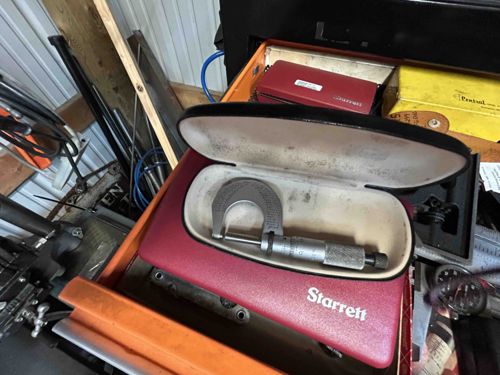
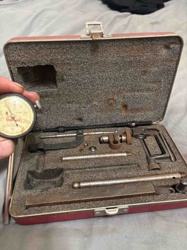
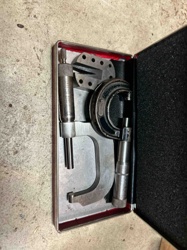
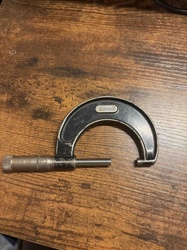
The item is a micrometer, specifically appearing to be an outside micrometer, housed within its protective case. The micrometer itself is constructed primarily of metal, likely steel or a similar alloy, given its typical application for precise measurements. It features a "C" shaped frame, a thimble with finely marked graduations, and an anvil and spindle for gripping the object to be measured. The visible surfaces are a matte silver-gray, indicating a natural metal finish or a protective coating. There is a clear Starrett manufacturing mark visible on the outside of the red case, suggesting a brand known for quality precision tools. The overall condition appears used, with some visible dust and grime within the case, and possibly light surface wear on the micrometer itself, consistent with workshop use. There are no obvious signs of significant damage such as deep scratches, rust, or deformation, which is crucial for a measuring instrument. The thimble and sleeve have clearly etched or engraved markings for measurement. The design appears to be a standard industrial-grade micrometer, likely from the mid to late 20th century given the traditional design and branding. The craftsmanship appears to be robust, designed for accuracy and durability in a professional or hobbyist setting. The black hinged plastic or hard rubber case with a red lining provides good protection for the instrument.
AI Appraisal Report
Upon examining the provided image of the Starrett Outside Micrometer with its protective case, I can offer the following professional appraisal. The micrometer appears to be a standard industrial-grade precision measuring instrument, consistent with Starrett's reputation for quality. Its construction, primarily of metal with finely marked graduations on the thimble and sleeve, indicates expected durability and accuracy for such a tool. Visually, the micrometer and its case exhibit signs of use, including some dust and grime, which is typical for a tool that has been utilized in a workshop or similar environment. However, there are no immediate visual cues of significant damage such as deep rust, impact deformation, or excessive wear that would compromise its function. The clear "Starrett" branding on the case strongly suggests authenticity; without physical inspection, however, I cannot definitively verify the authenticity of the micrometer itself beyond the case.
Market conditions for used precision tools like this tend to be steady. Starrett, Mitutoyo, and Brown & Sharpe are well-regarded brands, and their tools often retain a percentage of their new value. There isn't significant rarity associated with standard size micrometers like this, and demand primarily comes from hobbyists, students, and professionals needing a reliable, affordable tool. Factors impacting value include the precise model number (not discernable from the image), measurement range, and, most critically, its current functional accuracy. Minor cosmetic wear is expected, but any deviation from calibration would drastically reduce its value. Full authentication would require in-person inspection to verify serial numbers, test its accuracy against gauge blocks, and assess the smoothness of the thimble's action and the integrity of the spindle lock. Provenance documentation, though rare for tools of this nature, could also add to its history but not necessarily its functional value.