AI estimate as of August 20, 2025 · verify with a professional before acting
AI-Generated · Verify before acting
Everything on this page is generated by AI for informational purposes only. AI can make mistakes — the AI may misidentify items or misattribute them (artist, maker, brand, designer, origin, era). This is not an official valuation and should not be used for insurance, sale, tax, estate, legal, or lending purposes — or any decision requiring a certified appraisal. It is not an authoritative claim about any person, brand, or rights holder — do not share or rely on it as a factual statement about a third party. Always consult qualified professionals before making financial decisions.
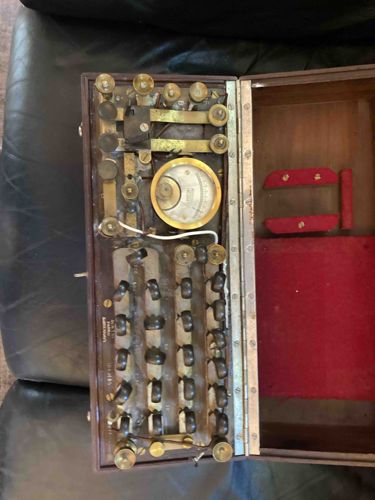
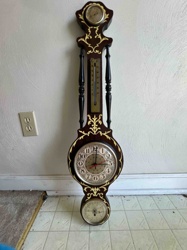
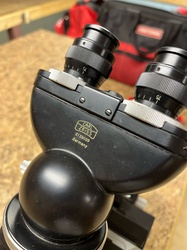
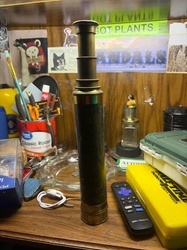
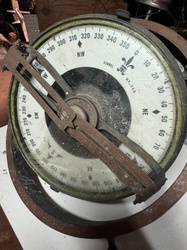
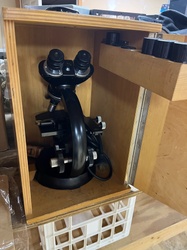
The item is an antique or vintage electrical measuring instrument, likely a Wheatstone bridge or a precision resistance box, housed within a wooden case. The case appears to be made of a dark-stained wood, possibly mahogany or walnut, and shows signs of age with a discernible patina. The interior of the lid, partially visible, is lined with red felt or velvet, with some elements indicating potential compartments for accessories. The primary functional components are mounted on a dark, possibly ebonite or bakelite, panel. These components are predominantly brass or bronze, showing oxidation and some tarnishing consistent with age and use. Notable features include numerous brass screw terminals or posts arranged in rows, likely for making electrical connections. There are also several switch-like mechanisms, possibly plugs or key-operated switches, with black or dark brown insulating handles. A prominent circular dial with a brass bezel and a white or cream-colored face is visible, likely an analog meter or galvanometer, essential for null detection in resistance measurements. There are also several horizontal brass strips, which might be busbars or sections of the resistance network. The overall construction appears robust and indicative of precision engineering for its period. The visible wear, such as surface scratches on the wood and tarnishing on the metal, suggests a history of handling and display. One textual marking is partially visible on a vertical strip, possibly reading 'Laboratory' or a similar designation, which could indicate its intended use or manufacturer. The estimated age is late 19th to early 20th century, given the materials, construction style, and the appearance of the electrical components.
AI Appraisal Report
Based on my examination of the provided image, this antique electrical measuring instrument, likely a Wheatstone bridge or precision resistance box, presents as a charming example of scientific apparatus from the late 19th to early 20th century.
**Condition and Authenticity:** The overall condition appears consistent with its age. The dark-stained wooden case exhibits a desirable patina, surface scratches, and minor scuffs, which are expected and contribute to its antique appeal rather than detracting significantly. The brass components show appropriate oxidation and tarnishing. The red felt lining, though partially visible, suggests a quality piece. Authenticity, based solely on visual inspection, seems high given the period-correct materials and construction methods. The partially visible textual marking 'Laboratory' further supports its historical context. However, a definitive assessment of internal components, wiring integrity, and operational functionality cannot be made without a hands-on examination.
**Market Conditions and Comparables:** The market for antique scientific instruments is niche but stable, with steady demand from collectors, educational institutions, and interior designers. Comparable items, such as D.A.R. (Decade and Resistance) boxes or other Wheatstone bridges from the specified period, typically fetch values ranging from a few hundred to several thousand dollars, depending on the manufacturer, completeness, and functional status.
**Demand and Rarity:** While not exceedingly rare, precision electrical instruments of this era, especially those in relatively good cosmetic condition, are not ubiquitous. The presence of a galvanometer is a significant plus, as it indicates a more complete and functional unit. Demand is driven by both their historical significance as tools of scientific advancement and their aesthetic appeal as decorative objects.
**Factors Impacting Value:** Key factors positively influencing value include its apparent completeness, period authenticity, and relatively good cosmetic state. The unknown operational status is the primary limitation. A working instrument commands a substantial premium. Other factors include the manufacturer (if identifiable), specific model, and the number and range of resistance coils.
**Limitations in Authenticity Verification:** Without physical inspection, I cannot confirm the integrity of the internal electrical components, the functionality of the galvanometer, or the completeness of all original parts. An in-person examination would allow for verification of materials, assessment of internal wiring, and testing of electrical functionality. Provenance documentation, if available, such as original sales receipts or historical records of ownership, would also greatly enhance its authentication and value.