AI Appraisal Estimate

AI-generated estimates · not official valuations

From the user

What was submitted

Photo and notes provided by the user — not generated by AI

Submitted item photo
Submitted photo · June 25, 2026

User's notes

No additional notes provided.

AI analysis below

AI appraisal

AI analysis & estimate

AI-Generated · Verify before acting

Everything below is generated by AI for informational purposes only. AI can make mistakes — the AI may misidentify items or misattribute them (artist, maker, brand, designer, origin, era). This is not an official valuation and should not be used for insurance, sale, tax, estate, legal, or lending purposes — or any decision requiring a certified appraisal. It is not an authoritative claim about any person, brand, or rights holder — do not share or rely on it as a factual statement about a third party. Always consult qualified professionals before making financial decisions.

Read the full disclaimer

AI Identification

·Not independently authenticated·Verify before acting

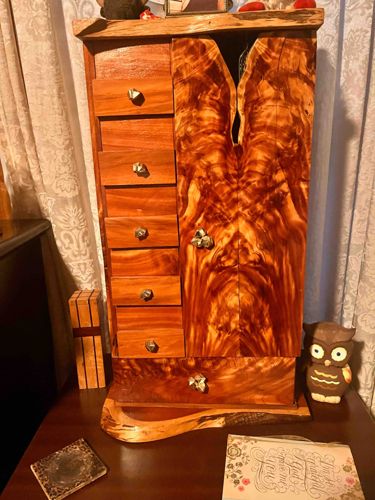
Hand-Crafted Live Edge Jewelry Armoire

Furniture / Decorative Arts

AI Estimated Value

·Not an official valuation·Verify before acting

$2,800 - $4,200

As of June 25, 2026

AI Item Analysis

·AI can make mistakes·Verify before acting
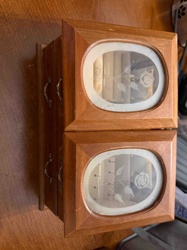
This is a custom-made, small-scale jewelry armoire featuring a striking combination of live-edge woodcraft and bookmatched cabinetry. The piece is constructed from a richly figured hardwood with prominent orange and auburn tones, likely cedar, redwood, or cherry, showcasing an intense flame-like grain pattern. The design consists of seven graduated drawers on the left-hand side and a larger vertical cabinet door on the right with a distinctive curved, organic opening at the top. A large horizontal drawer spans the base of the unit. The top and bottom base plates are made from live-edge slabs, preserving the natural bark-line texture and organic silhouette of the tree. The drawer pulls are unique, faceted crystalline or metallic knobs with a raw, geometric aesthetic that contrasts with the fluid wood grain. The finish appears to be a high-gloss lacquer or oil-rubbed finish that enhances the chatoyancy of the wood. The construction demonstrates high-level artisan craftsmanship, particularly in the bookmatching of the cabinet door panels to create a symmetrical 'mirrored' grain effect. The condition appears to be excellent with a well-preserved patina, no visible structural damage, and clean alignment of the custom-fit drawers. This piece likely dates from the late 20th century to the present, reflecting a 'Studio Furniture' style influenced by woodworkers such as George Nakashima.
AI Appraisal Report

·AI can make mistakes·Verify before acting
I have virtually examined this hand-crafted jewelry armoire, which exemplifies the 'Studio Furniture' movement. The piece displays exceptional artisan quality, particularly in the use of high-figure bookmatched hardwood (likely aromatic cedar or highly figured cherry) and the integration of live-edge slabs for the top and base. The mirror-image grain on the cabinet door indicates a sophisticated level of material selection and milling. The condition appears to be excellent; the high-gloss finish remains vibrant with no visible checking, and the drawer alignment suggests precise joinery work. Market demand for bespoke, organic modern furniture influenced by George Nakashima remains strong, particularly for functional items like jewelry storage that double as sculptural art. Comparables for unsigned studio pieces of this scale range from $1,500 to $3,000, while documented works by recognized American Craftsmen can exceed $6,000. The rarity of the natural grain pattern significantly bolsters its value. However, a conclusive evaluation is limited by the digital format. In-person inspection is required to verify the specific wood species and assess the interior joinery—such as the presence of dovetails versus glued joints—which dictates the difference between 'boutique' and 'master' craftsmanship. I would also seek a maker's mark or signature, often hidden on the underside of drawers. Full authentication would require provenance documentation or a certificate of authenticity from the original artisan to reach the high end of the estimated value.

Get your items appraised

Instant estimates of your treasures with AI-powered appraisals

Browse More Appraisals