AI estimate as of October 1, 2025 · verify with a professional before acting
AI-Generated · Verify before acting
Everything on this page is generated by AI for informational purposes only. AI can make mistakes — the AI may misidentify items or misattribute them (artist, maker, brand, designer, origin, era). This is not an official valuation and should not be used for insurance, sale, tax, estate, legal, or lending purposes — or any decision requiring a certified appraisal. It is not an authoritative claim about any person, brand, or rights holder — do not share or rely on it as a factual statement about a third party. Always consult qualified professionals before making financial decisions.
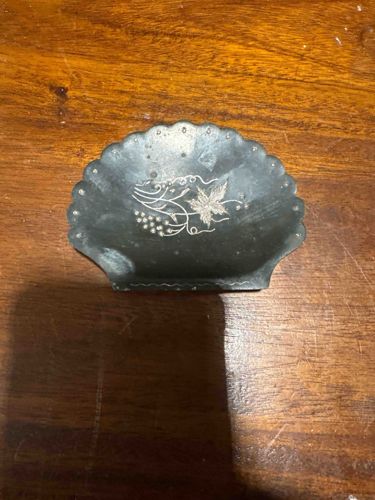
This item is a small, decorative trinket dish, shaped in the form of a scallop shell. Its primary color appears to be a dark, possibly oxidized, metallic tone, likely silver-plated or made of a base metal like pewter or a dark bronze alloy. The surface has a matte to slightly satin finish, showing some minor wear and possibly a natural patina that contributes to its dark appearance. The physical construction features a scalloped edge around its perimeter, lending it a delicate and classic aesthetic. The interior of the dish is adorned with an engraved or applied silver-colored motif depicting a detailed grapevine with leaves and clusters of grapes. This decorative element is predominantly on the left side of the dish, creating an asymmetrical design. There are also small, possibly raised dot-like embellishments along the inner edge of the scalloping, enhancing its ornamental appeal. The dimensions appear to be small, suggesting its use as a catch-all for small jewelry, coins, or as a decorative accent. While no specific maker's marks or signatures are discernible from the provided images, the style of the grapevine motif and the use of a dark metal with silver detailing suggest a possible Victorian to early 20th-century period, or a reproduction in a similar style. The item shows signs of age and use, including potential surface scratches and areas where the dark finish might be slightly worn, revealing a lighter metal underneath. The craftsmanship appears to be of decent quality, with clear detailing in the engraved motif and well-formed edges.
AI Appraisal Report
Upon visual examination of the provided image, I assess this scalloped shell-shaped trinket dish with a grapevine motif. The item appears to be in good, aged condition, consistent with its likely age. The dark metallic tone, possibly oxidized silver-plate, pewter, or a dark bronze alloy, exhibits a desirable patina and minor wear, which is expected for such decorative pieces and generally adds to its character rather than detracting significantly from value. The detailed grapevine motif, executed in a silver-colored finish against the darker background, showcases decent craftsmanship.
Authenticity, based solely on imagery, is challenging to definitively confirm. However, the style of the grapevine motif and the metal combination suggest a period from the late Victorian to early 20th century, or a later reproduction in a similar aesthetic. Without maker's marks or further provenance, it's difficult to pinpoint an exact origin or age with certainty.
Market conditions for small decorative trinket dishes of this nature are generally steady but not exceptionally high. Comparable items, often found in antique malls or online marketplaces, typically fall within a modest price range. Demand is moderate, appealing primarily to collectors of decorative arts, small silver-plated items, or those looking for period-appropriate home accents. The item is not exceptionally rare, though its specific design might be unique.
Factors impacting value include its condition, the aesthetic appeal of the grapevine motif, and the overall quality of craftsmanship. The lack of identifiable maker's marks is a limiting factor in achieving a higher valuation, as branded pieces often command a premium. To fully authenticate and confirm the material composition and precise age, an in-person examination would be crucial. This would allow for detailed inspection of manufacturing techniques, material testing (e.g., acid testing for silver content), and a thorough search for subtle hallmarks or signatures that may not be visible in photographs.