These notes were written by the person who submitted this item. Appraiser.AI has not verified them, and the AI's identification and estimate may rely on them.
AI Estimated Value
Not an official valuation
$65-95
AI estimate as of November 5, 2025 · verify with a professional before acting
AI-Generated · Verify before acting
Everything on this page is generated by AI for informational purposes only. AI can make mistakes — the AI may misidentify items or misattribute them (artist, maker, brand, designer, origin, era). This is not an official valuation and should not be used for insurance, sale, tax, estate, legal, or lending purposes — or any decision requiring a certified appraisal. It is not an authoritative claim about any person, brand, or rights holder — do not share or rely on it as a factual statement about a third party. Always consult qualified professionals before making financial decisions.
This analysis also relies on unverified notes provided by the user, which may be incomplete or inaccurate and could affect the result.
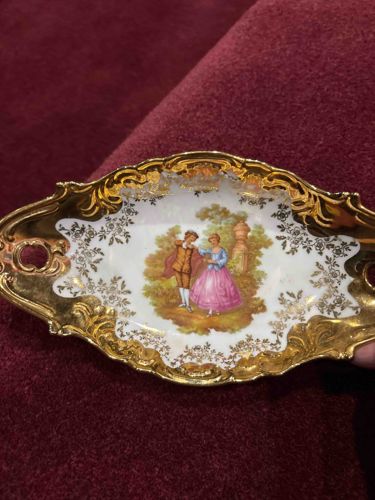
This is an exquisitely crafted decorative trinket dish, likely made from porcelain or fine china, featuring a vibrant, hand-painted romantic scene at its center. The dish has an ornate, scalloped rectangular shape with gracefully curved sides and prominent, pierced handles on either end. The dominant colors are a rich, lustrous gold gilding that heavily adorns the border, handles, and intricate floral patterns within the white central field. The central vignette depicts two figures, a gentleman in brown and gold attire and a lady in a pink and blue gown, standing amidst a verdant landscape with trees and architectural elements, rendered in a palette of greens, browns, and soft yellows. The style of dress and the romantic theme suggest a Rococo or Neo-Rococo influence, dating it possibly to the late 19th or early 20th century. The gold details, particularly the raised scrollwork on the edges and handles, indicate a high level of craftsmanship. The white background of the dish is embellished with delicate golden floral or foliate motifs, adding to its opulent aesthetic. No significant visible damage, such as chips or cracks, is apparent from the image, although minor wear to the gilding, common with age and handling, may be present upon closer inspection. The mention of 'Klieber Bavaria' suggests it is a product of a manufacturer from Bavaria, Germany, known for quality porcelain. The overall appearance is luxurious and designed for display, likely for holding small items or simply as an ornamental piece.
AI Appraisal Report
Upon visual examination of the images provided, this Klieber Bavaria decorative trinket dish presents as a fine example of early 20th-century German porcelain. The piece is characterized by its ornate, scalloped form, heavy gold gilding, and a central transferware vignette with hand-painted accents depicting a romantic Rococo-style scene. The condition appears to be very good to excellent, with no visible chips, cracks, or crazing. The gilding is vibrant and largely intact, which is a significant value factor. The pierced handles and raised scrollwork are indicative of quality craftsmanship typical of the Bavarian region during this era. Klieber was a known porcelain decorator, and this style was popular, resulting in a relatively high production volume. The market for this type of decorative porcelain is stable but modest. Comparable Klieber Bavaria dishes and similar pieces from other German makers of the period typically sell in the $50 to $100 range at auction and on secondary online marketplaces. The primary value driver is its decorative appeal and excellent condition. Demand is steady among collectors of German porcelain and those seeking traditional decorative arts. A key limitation of this appraisal is the inability to physically inspect the item. A full authentication would require examining the piece for any hidden repairs under UV light, verifying the maker's mark against known examples, and inspecting the wear patterns in person to confirm its age. Without such direct examination, its authenticity is presumed based on the visual characteristics.