AI Appraisal Estimate

AI-generated estimates · not official valuations

From the user

What was submitted

Photo and notes provided by the user — not generated by AI

Submitted item photo
Submitted photo · May 24, 2026

User's notes

No additional notes provided.

AI analysis below

AI appraisal

AI analysis & estimate

AI-Generated · Verify before acting

Everything below is generated by AI for informational purposes only. AI can make mistakes — the AI may misidentify items or misattribute them (artist, maker, brand, designer, origin, era). This is not an official valuation and should not be used for insurance, sale, tax, estate, legal, or lending purposes — or any decision requiring a certified appraisal. It is not an authoritative claim about any person, brand, or rights holder — do not share or rely on it as a factual statement about a third party. Always consult qualified professionals before making financial decisions.

Read the full disclaimer

AI Identification

·Not independently authenticated·Verify before acting

Porcelain Floral Trinket Dish with Scalloped Edge

Decorative Collectible

AI Estimated Value

·Not an official valuation·Verify before acting

$25-45

As of May 24, 2026

AI Item Analysis

·AI can make mistakes·Verify before acting
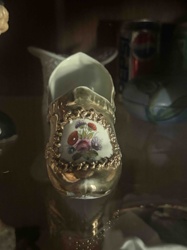
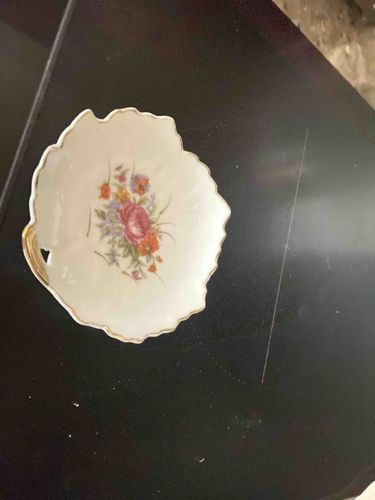
This item is a decorative porcelain trinket dish featuring an irregularly shaped, scalloped edge, suggesting a leaf-like or organic form. It measures approximately 6-8 inches at its widest point, though precise dimensions are not ascertainable from the image. The dish is crafted from a fine, creamy-white porcelain, exhibiting a smooth, glossy glaze. Its primary decorative element is a vibrant floral motif centrally placed within the dish, depicting a clustered bouquet of flowers. The bouquet includes a prominent rose in shades of deep pink and red, surrounded by smaller blossoms in orange, purple, light blue, and yellow, nestled amidst green foliage. The artistic style of the floral painting appears to be somewhat naturalistic yet idealized. A significant feature is the gold-painted trim that meticulously outlines the entire scalloped rim of the dish, adding a touch of elegance and luxury. There is also a small, gold-painted handle-like protrusion on one side, which further accentuates the leaf or shell-like design. \nFrom the image, the dish appears to be in good overall condition with no obvious chips, cracks, or significant wear visible on the painted surface or edges, though some minor gilt loss might be present on closer inspection, which is common with age. The black surface underneath shows some dust and minor scuffs, but these are not part of the item itself. The dish likely dates from the early to mid-20th century, a period known for such decorative porcelain wares. The quality of the porcelain and the hand-painted details suggest a level of craftsmanship indicative of fine china production.

AI Appraisal Report

·AI can make mistakes·Verify before acting
Upon visual examination of the provided image, I have assessed this porcelain floral trinket dish. It presents as a well-preserved piece, likely dating from the early to mid-20th century. The dish is crafted from fine, creamy-white porcelain with a vibrant, centrally located hand-painted floral bouquet and an elegant gold-gilt scalloped rim. The dish appears to be in very good condition, with no visible chips, cracks, or crazing. The paint and gilt appear largely intact, though minor age-appropriate wear to the gold trim is possible and expected. The quality of the painting suggests competent, but likely not high-end, factory decoration common for the period. The market for such decorative porcelain dishes is quite broad. Without a discernible maker's mark, the value is determined primarily by its decorative appeal rather than by brand recognition or rarity. Similar unmarked, mid-century porcelain dishes from German, Japanese, or American manufacturers are readily available. Current market comparables place items of this type in the $25 to $45 range, depending on the sales venue. Its value is driven by its aesthetic qualities and its utility as a decorative 'catch-all' dish. My appraisal is limited by the inability to physically inspect the item. A full authentication would require an in-person examination to identify any maker's marks on the underside, which are critical for determining origin and manufacturer. Verifying the condition for any hairline cracks or restoration not visible in photos would also be necessary. Without a mark, it remains an attractive, but generic, collectible.

Get your items appraised

Instant estimates of your treasures with AI-powered appraisals

Browse More Appraisals