AI estimate as of December 7, 2025 · verify with a professional before acting
AI-Generated · Verify before acting
Everything on this page is generated by AI for informational purposes only. AI can make mistakes — the AI may misidentify items or misattribute them (artist, maker, brand, designer, origin, era). This is not an official valuation and should not be used for insurance, sale, tax, estate, legal, or lending purposes — or any decision requiring a certified appraisal. It is not an authoritative claim about any person, brand, or rights holder — do not share or rely on it as a factual statement about a third party. Always consult qualified professionals before making financial decisions.
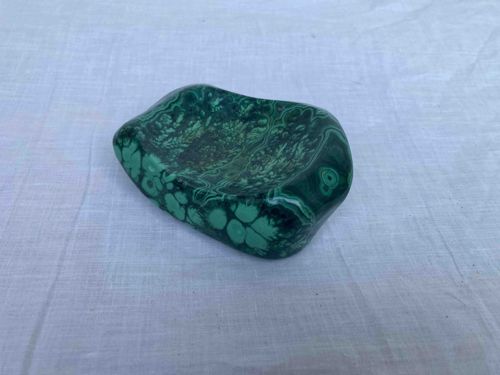
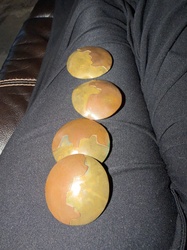
This item is a polished malachite trinket dish, characterized by its striking natural patterns and vibrant green hues. The dish is irregularly shaped, with soft, rounded edges and a shallow, concave interior, suggesting it was carved or tumbled from a larger piece of malachite. Its color ranges from a deep, almost blackish-green to a brighter, lighter green, all fluidly transitioning through characteristic concentric banding, 'bulls-eye' patterns, and feathery, botryoidal formations. The surface appears highly polished, giving it a smooth, glossy finish that enhances the visual depth and richness of the malachite's natural veining. There are no visible chips, cracks, or significant abrasions from the provided image, indicating good to excellent condition. The craftsmanship appears to be focused on showcasing the natural beauty of the stone, with the shape organically following the material's properties. While there are no discernable manufacturer's marks or signatures visible, the quality of the polish and the careful shaping suggest a skilled artisan. This piece likely dates from the late 20th century to the present day, a common period for decorative crystal and mineral items. Its unique patterns make it a distinct decorative object, suitable for holding small jewelry or as an aesthetic accent.
AI Appraisal Report
Based on my visual examination of the provided image, this malachite polished trinket dish presents in excellent condition. The surface exhibits a high polish, enhancing the natural banding, 'bulls-eye' patterns, and botryoidal formations characteristic of malachite. I detect no visible chips, cracks, or significant abrasions. The irregular, organic shape suggests the craftsman prioritized showcasing the stone's natural beauty. Authenticity, based solely on visual inspection, appears strong; the colors and patterns are consistent with genuine malachite. However, without physical examination, I cannot definitively rule out highly convincing synthetic malachite or a composite material. An in-person inspection would allow me to assess the specific gravity, hardness, and internal structure more accurately. Scientific testing, such as Raman spectroscopy, would provide conclusive authentication.
In terms of market conditions, malachite decorative objects like this are consistently desired, particularly for their aesthetic appeal and perceived natural energy. Comparables in similar condition and size typically range from $70-$150. While not exceedingly rare, high-quality malachite pieces with distinct patterns like this one command a better price. Demand is steady, driven by interior design trends and collectors of natural stone items. The primary factors impacting value are the size (which is difficult to ascertain precisely from an image), the intensity and intricacy of the natural patterns, and the flawless condition. Should it prove to be a particularly large or heavy piece, the value could be higher. As an appraiser, I'd need to feel the weight and scale to provide a more precise value within that range.