AI Appraisal Estimate

AI-generated estimates · not official valuations

From the user

What was submitted

Photo and notes provided by the user — not generated by AI

Submitted item photo
Submitted photo · June 28, 2026

User's notes

No additional notes provided.

AI analysis below

AI appraisal

AI analysis & estimate

AI-Generated · Verify before acting

Everything below is generated by AI for informational purposes only. AI can make mistakes — the AI may misidentify items or misattribute them (artist, maker, brand, designer, origin, era). This is not an official valuation and should not be used for insurance, sale, tax, estate, legal, or lending purposes — or any decision requiring a certified appraisal. It is not an authoritative claim about any person, brand, or rights holder — do not share or rely on it as a factual statement about a third party. Always consult qualified professionals before making financial decisions.

Read the full disclaimer

AI Identification

·Not independently authenticated·Verify before acting

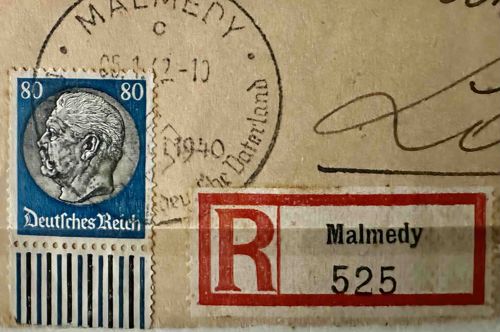
1940 German Philatelic Registered Cover Fragment with Paul von Hindenburg Stamp

Philately / Postal History

AI Estimated Value

·Not an official valuation·Verify before acting

$15-25

As of June 28, 2026

AI Item Analysis

·AI can make mistakes·Verify before acting
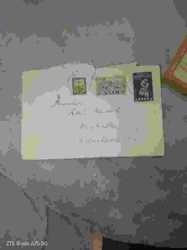
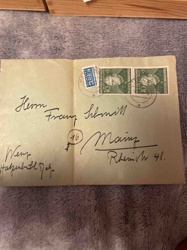
This item is a historical postal fragment originating from the Deutsches Reich (Third Reich) era. It features an 80-pfennig definitive postage stamp from the 'President Paul von Hindenburg' series, printed in a deep blue ink with a black and white portrait medallion. The stamp is affixed to a buff-colored, textured paper envelope. Key features include a perforated edge and a vertical bar 'han' (house order) marking on the bottom margin. The stamp is cancelled with a circular date stamp (CDS) from Malmedy, dated November 5, 1940, reflecting the annexation of the Eupen-Malmedy region during WWII. Adjacent to the stamp is a red and white 'R' registration label marked 'Malmedy 525'. The paper shows significant aging, yellowing, and minor creasing consistent with its 80-year history. The cancellations and markings are clear and legible, providing strong provenance for postal history specialists. This philatelic piece represents a specific geopolitical moment when Malmedy was under German administration, making it a significant item for collectors of World War II postal history and occupational issues.
AI Appraisal Report

·AI can make mistakes·Verify before acting
I have examined the digital image of this 1940 German postal fragment featuring the 80-pfennig Paul von Hindenburg definitive stamp. The stamp itself is a common issue (Michel No. 526), but the value here lies entirely in the usage and cancellation. The cancellation is from Malmedy, dated November 5, 1940. This is historically significant as it documents the period shortly after Germany re-annexed the Eupen-Malmedy region from Belgium in May 1940. The cancellation appears crisp and legible, which is desirable for collectors of 'Heim ins Reich' or annexed territory postal history. However, this is only a fragment (a piece cut from the original envelope), not a full cover. Full covers command significantly higher premiums because they provide complete context, including addressee and arrival markings. The preservation of the registration label ('Einschreiben Malmedy 525') adds some interest, as does the 'HAN' marking on the stamp's selvage, indicating specific printing sheet details. Condition-wise, the paper shows expected toning and rough edges typical of a cut fragment. Authenticity of the overprint/cancellation is the primary concern with WWII-era occupation material. While the fonts and spacing of the Malmedy cancel look consistent with period examples, forgeries of cancellations in annexed territories are common. To fully authenticate this, a physical inspection using UV light to detect re-gumming or ink manipulation, and a microscopic review of the ink propagation on the cancellation, would be required. Currently, the market for Third Reich postal history is active but highly selective; fragments are generally relegated to lower-tier pricing or 'bargain bins' at shows. Consequently, I place the value in the $15-25 range as a curiosity piece rather than a premium investment item.

Get your items appraised

Instant estimates of your treasures with AI-powered appraisals

Browse More Appraisals