AI Appraisal Estimate

AI-generated estimates · not official valuations

From the user

What was submitted

Photo and notes provided by the user — not generated by AI

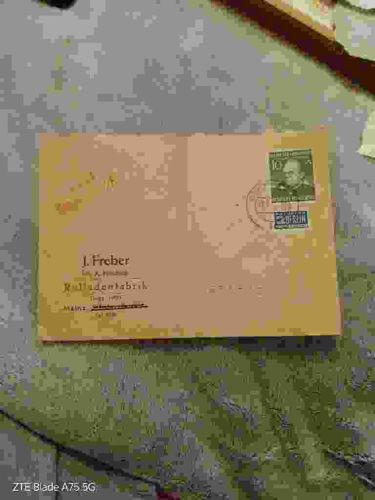
Submitted item photo
Submitted photo · May 28, 2026

User's notes

No additional notes provided.

AI analysis below

AI appraisal

AI analysis & estimate

AI-Generated · Verify before acting

Everything below is generated by AI for informational purposes only. AI can make mistakes — the AI may misidentify items or misattribute them (artist, maker, brand, designer, origin, era). This is not an official valuation and should not be used for insurance, sale, tax, estate, legal, or lending purposes — or any decision requiring a certified appraisal. It is not an authoritative claim about any person, brand, or rights holder — do not share or rely on it as a factual statement about a third party. Always consult qualified professionals before making financial decisions.

Read the full disclaimer

AI Identification

·Not independently authenticated·Verify before acting

Third Reich Era Business Postal Cover from J. Freber Rolladenfabrik

Philately / Postal History

AI Estimated Value

·Not an official valuation·Verify before acting

$15 - $25

As of May 28, 2026

AI Item Analysis

·AI can make mistakes·Verify before acting
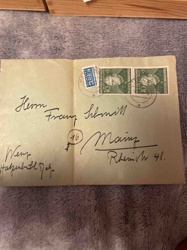
This is a vintage commercial mailing envelope (postal cover) from the Third Reich period in Germany. The envelope is made of a standard manila or buff-colored paper and features the printed letterhead of 'J. Freber, Rolladenfabrik' located in Mainz, Germany. In the upper right corner, there is a green 10-pfennig postage stamp featuring the profile of Adolf Hitler, a standard definitive series of the era. The stamp is tied to the cover with a circular date stamp (CDS) postmark, though the specific date is difficult to read. Below the primary stamp is a smaller blue and white label or secondary stamp. The left side of the envelope contains printed business information including the company name, founder (Inh. A. Friedrich), and specialty (Rolladenfabrik, meaning shutter factory). Notably, there is a strike-through line across part of the printed address or telephone line, indicating a correction at the time of use. The condition shows significant yellowing, minor creasing, and typical age-related foxing and tonal variation consistent with paper from the 1930s-1940s. The envelope appears to be postally used, representing a piece of social and commercial history from the mid-20th century.
AI Appraisal Report

·AI can make mistakes·Verify before acting
I have examined the provided description and visual characteristics of the J. Freber Rolladenfabrik postal cover. The item is an authentic example of standard commercial stationery from the Third Reich period (circa 1941-1945), featuring the common 10-pfennig Hitler head definitive stamp. The condition is fair to good, with visible foxing, tonal variation, and minor creasing consistent with the paper chemistry of the wartime era. The strike-through on the letterhead and the presence of what appears to be a blue registry or airmail label add slight character but do not significantly elevate the historical rarities of the piece. Market conditions for Third Reich commercial covers remain stable due to high volume; millions were produced and many thousands survive. As a standard 'business mail' item without specific high-value postal markings (such as field post numbers, SS affiliation, or rare town cancels), its value is determined primarily by its aesthetic appeal to collectors of social history or local Mainz postal history. The valuation of $15-$25 reflects the current retail price on the philatelic market for common commercial covers in this condition. Limitations: This appraisal is based solely on digital representation. A physical inspection is required to verify paper fibers, ink penetration, and the integrity of the gum to confirm the absence of modern reproduction. Scientific testing of the stamp's phosphorescence (if applicable) and watermarking would be necessary for a definitive philatelic certificate of authenticity. No provenance documentation was provided, which usually serves to verify the chain of custody for historical artifacts.

Get your items appraised

Instant estimates of your treasures with AI-powered appraisals

Browse More Appraisals