AI Appraisal Estimate

AI-generated estimates · not official valuations

From the user

What was submitted

Photo and notes provided by the user — not generated by AI

Submitted item photo
Submitted photo · May 28, 2026

User's notes

No additional notes provided.

AI analysis below

AI appraisal

AI analysis & estimate

AI-Generated · Verify before acting

Everything below is generated by AI for informational purposes only. AI can make mistakes — the AI may misidentify items or misattribute them (artist, maker, brand, designer, origin, era). This is not an official valuation and should not be used for insurance, sale, tax, estate, legal, or lending purposes — or any decision requiring a certified appraisal. It is not an authoritative claim about any person, brand, or rights holder — do not share or rely on it as a factual statement about a third party. Always consult qualified professionals before making financial decisions.

Read the full disclaimer

AI Identification

·Not independently authenticated·Verify before acting

Mid-20th Century German Philatelic Cover (Postmarked Envelope)

Philately / Postal History

AI Estimated Value

·Not an official valuation·Verify before acting

$5.00 - $12.00

As of May 28, 2026

AI Item Analysis

·AI can make mistakes·Verify before acting
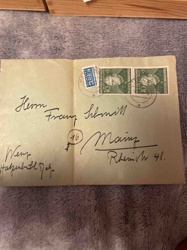
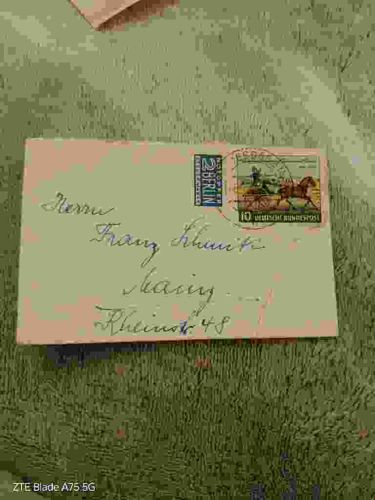
This item is a standard rectangular paper envelope, likely from the mid-20th century, specifically post-World War II West Germany. It features a handwritten address in blue-black ink, indicating the recipient is Franz Khunitz in Mainz, Rheinstr. 48. The envelope is notable for its philatelic elements: it bears a 10 Pfennig 'Deutsche Bundespost' stamp depicting a horse-drawn carriage and a smaller 'Notopfer Berlin' (Berlin Emergency Tax) stamp. The Berlin tax stamp was a blue-and-white 2-pfennig surcharge required on domestic West German mail from 1948 to 1956 to support the blockaded city of Berlin. The main stamp is cancelled with a circular postmark that appears to be from Essen, dated in the 1950s. The paper shows general signs of age with light tanning, minor creasing, and softened corners. There is some slight discoloration or staining visible on the surface. The handwriting is in a formal, cursive script typical of the mid-century European style. The combination of the definitive series stamp and the specific Berlin tax seal makes this a classic example of Cold War-era postal history from the Federal Republic of Germany.
AI Appraisal Report

·AI can make mistakes·Verify before acting
I have examined the digital representation of this mid-20th-century German philatelic cover. The item features a 10 Pfennig 'Heuss' or 'Postage' series definitive alongside a required 2 Pfennig 'Notopfer Berlin' tax stamp. The cancellation from Essen appears consistent with postal practices of the early 1950s. The condition shows standard signs of circulation, including light foxing, corner softening, and paper tanning, which is typical for post-war domestic mail. From a market perspective, this is a very common piece of West German postal history. Millions of these tax stamps were issued between 1948 and 1956; consequently, demand is primarily limited to specialty collectors of Berlin tax markings or local postal history of Essen. The handwriting is clear and the stamps are well-centered, though commonality keeps rarity low. Critically, while the stamps and postmark appear authentic, a digital image cannot verify paper grain, glue composition, or the presence of hidden repairs. A full authentication would require an in-person physical examination to check watermarks, verify the ink depth of the cancel, and ensure the cover was not 'prepared' later for collectors. No provenance documentation was provided, which is typical for items of this value range, but for a higher valuation, one would look for rare destination addresses or unusual combinations of franking. In its current state, it remains a charming but affordable piece of Cold War history.

Get your items appraised

Instant estimates of your treasures with AI-powered appraisals

Browse More Appraisals