AI estimate as of December 12, 2025 · verify with a professional before acting
AI-Generated · Verify before acting
Everything on this page is generated by AI for informational purposes only. AI can make mistakes — the AI may misidentify items or misattribute them (artist, maker, brand, designer, origin, era). This is not an official valuation and should not be used for insurance, sale, tax, estate, legal, or lending purposes — or any decision requiring a certified appraisal. It is not an authoritative claim about any person, brand, or rights holder — do not share or rely on it as a factual statement about a third party. Always consult qualified professionals before making financial decisions.
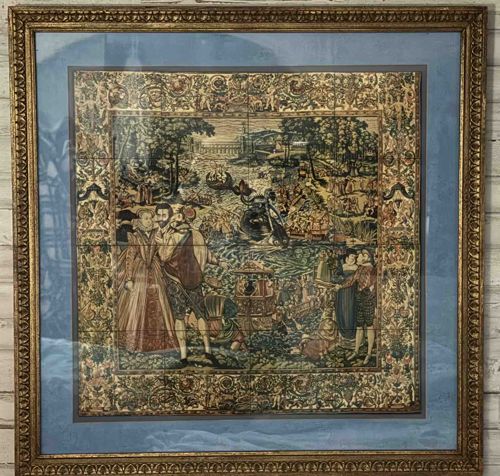
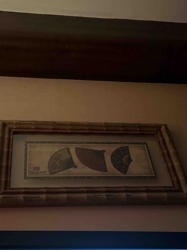
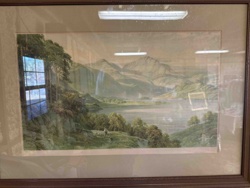
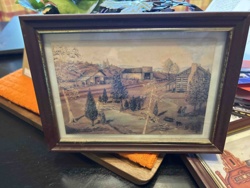
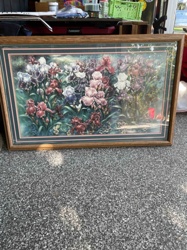
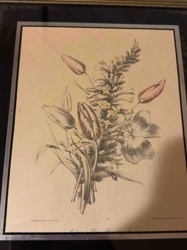
This item is a framed print, likely a reproduction, featuring a detailed tapestry-like image. The central image depicts a multi-figural scene set in an ornate landscape, possibly illustrating a narrative or allegorical theme. Figures in historical attire, reminiscent of 17th or 18th-century European fashion, are positioned throughout a verdant setting with trees, hills, and architectural elements such as a bridge in the background. The color palette is rich and somewhat muted, dominated by earth tones, blues, greens, and reds, giving it an aged, traditional aesthetic. The central image is surrounded by an intricately patterned border, characteristic of Rococo or Baroque decorative motifs, featuring flora, scrolls, and possibly grotesque figures. This border itself appears to be part of the print, mimicking a woven textile or carved frame. The print is matted with a wide blue border, which provides a serene contrast to the detailed artwork. The entire piece is enclosed in a multi-layered gold-colored ornate frame, exhibiting a repeating pattern that suggests a classical or historical stylistic influence. The frame shows some signs of wear, particularly along the edges and corners, with minor chipping or rubbing visible, indicating its age and handling. The print itself appears to be under glass or acrylic, which reflects some light and obscures a truly clear view of the print's surface texture. The overall condition appears good with no significant visible damage to the print itself, though the frame's wear contributes to a vintage character. The craftsmanship of the frame is decent, with molded details. The appearance suggests a decorative art piece intended for a traditional interior, likely from the mid to late 20th century, replicating older European tapestry designs.
AI Appraisal Report
Based on my visual examination of the provided image, this item is a framed print, likely a decorative reproduction rather than an authentic antique tapestry or a high-value original print. The condition of the print appears good, with the image itself free from visible damage under the protective glazing. The multi-layered gold-colored frame shows minor wear, including chipping and rubbing, which adds a vintage character without significantly detracting from its decorative appeal. The Rococo/Baroque border is part of the print, mimicking a woven design, further suggesting a reproduction.
My assessment of authenticity is limited by the visual nature of this appraisal. From the image, the item’s character suggests it was manufactured in the mid to late 20th century, replicating older European aesthetic. Market conditions for decorative prints of this nature are generally moderate. Comparables typically include mass-produced framed art, which usually fetches modest prices. The demand for such pieces is steady among those seeking traditional interior decor, but they are not considered rare. Factors impacting value are primarily its decorative appeal, the overall good condition of the print, and the moderately ornate frame.
To fully verify authenticity and to determine if it is a higher quality print (e.g., a limited edition fine art print), an in-person examination would be crucial. This would allow for inspection of the print's surface texture, printing method, paper quality, and any artist's signatures or edition numbers hidden by the frame or mat. Provenance documentation, though unlikely for an item of this type, would also confirm its origin and history. Scientific testing, such as pigment analysis, would be excessive and unnecessary for what appears to be a decorative reproduction.