AI estimate as of October 14, 2025 · verify with a professional before acting
AI-Generated · Verify before acting
Everything on this page is generated by AI for informational purposes only. AI can make mistakes — the AI may misidentify items or misattribute them (artist, maker, brand, designer, origin, era). This is not an official valuation and should not be used for insurance, sale, tax, estate, legal, or lending purposes — or any decision requiring a certified appraisal. It is not an authoritative claim about any person, brand, or rights holder — do not share or rely on it as a factual statement about a third party. Always consult qualified professionals before making financial decisions.
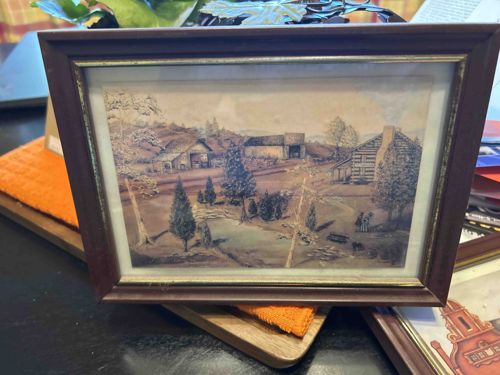
This item is a framed print depicting a rural landscape scene. The artwork itself appears to be a sepia-toned or monochromatic print, possibly a lithograph or engraving reproduction, featuring a dirt path winding through a bucolic setting. In the foreground, there are several evergreen trees and what looks like a small stream or pond. The middle ground features various structures, including a prominent log cabin with a stone chimney on the right, and other barn-like buildings in the distance towards the left, suggestive of a farmstead or village. Small, indistinct figures, possibly two people, can be seen near the log cabin. The background features rolling hills or mountains. The print is housed within a simple, dark brown wooden frame with a gold-colored inner fillet, providing a subtle accent. The frame has a classic, unadorned profile. The overall condition of the print appears good, with no obvious major tears, creases, or significant discoloration visible through the glass. The frame also seems to be in good condition with minor wear consistent with its age, but no apparent major damage like chips or cracks. The print likely dates from the mid-20th century to late 20th century, given its common subject matter and framing style. The craftsmanship is utilitarian, typical of mass-produced decorative wall art rather than fine art. There are no discernible artist signatures, maker's marks, or edition numbers visible in the image.
AI Appraisal Report
Based on my visual examination of the provided image, this framed print depicting a rural landscape appears to be a mass-produced decorative art piece, likely a sepia-toned lithograph or engraving reproduction. The overall condition of both the print and its simple dark brown wooden frame with a gold fillet appears good, with minor wear consistent with its age, likely mid-to-late 20th century. I observe no major tears, creases, significant discoloration to the print, or major damage like chips or cracks to the frame, all viewed through the glass. The craftsmanship is utilitarian, typical of decorative wall art.
Authenticity verification from images alone has significant limitations. I cannot definitively confirm the printing technique (e.g., lithograph, engraving, offset print) without physical inspection. There are no discernible artist signatures, edition numbers, or maker's marks visible, which typically indicates a decorative, mass-produced item rather than a fine art print.
Given the mass-produced nature, common subject matter, and utilitarian framing style, demand for such items in the secondary market is generally low. These pieces often resurface in thrift stores, estate sales, or online marketplaces at modest prices. Comparables include similar decorative landscape prints from the mid to late 20th century, which typically retail for under $50. Rarity is not a factor here; these were widely produced.
Factors impacting value: The primary factor preventing a higher valuation is its identity as a decorative reproduction rather than an original artwork or limited-edition fine art print. The lack of an identifiable artist or provenance also limits its collectibility. A full authentication would require in-person examination to verify print type, paper quality, and to search for any obscured marks. Provenance documentation would also be valuable but is highly unlikely for this type of item.