AI estimate as of November 5, 2025 · verify with a professional before acting
AI-Generated · Verify before acting
Everything on this page is generated by AI for informational purposes only. AI can make mistakes — the AI may misidentify items or misattribute them (artist, maker, brand, designer, origin, era). This is not an official valuation and should not be used for insurance, sale, tax, estate, legal, or lending purposes — or any decision requiring a certified appraisal. It is not an authoritative claim about any person, brand, or rights holder — do not share or rely on it as a factual statement about a third party. Always consult qualified professionals before making financial decisions.
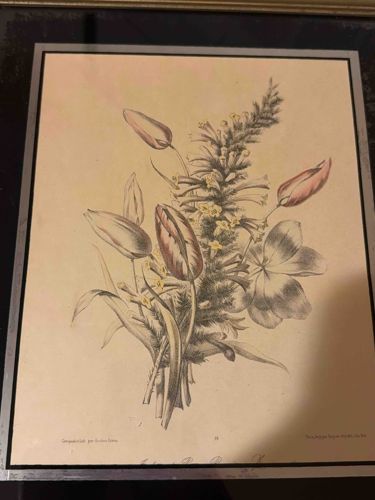
This item is a framed botanical print, featuring an arrangement of various floral and plant elements. The print is characterized by its somewhat muted color palette, primarily employing shades of gray, black, and subtle hints of red-purple for the tulip-like blooms and light yellow for smaller inflorescences. The central design depicts a bouquet-like cluster. Prominent within the composition are several closed or partially opened tulip-shaped flowers with striated petals, suggesting a detailed rendering technique. Interspersed among these are what appears to be a spike-like inflorescence with numerous tiny yellowish flowers, possibly a type of heather or similar plant, and two larger, broad-leafed flowers, one in the lower right, reminiscent of a geranium or similar species, also rendered in grayscale with delicate line work. The background of the print is a light, aged-looking beige or off-white. The craftsmanship indicates a fine art printing process, likely an engraving or lithograph, given the detailed lines and subtle color application. There are printed inscriptions at the bottom edge: on the left, it reads 'Compos&e et Grav&e par G. B&e. Deliaun&e.', suggesting the artist and engraver. On the right, likely 'éditeur, Rue des Francs-Bourgeois, No. 13.', indicating the publisher or printer's address. A number '16' is also visible at the bottom center. The print itself shows signs of age, with some slight discoloration or foxing visible in the beige background. It is housed within a simple, dark-colored frame, possibly wood, with a reflective, flat silver-colored inner border or mat, which appears to be metal or a metallic finish. The frame shows some minor wear consistent with age and handling. This item likely dates from the late 18th to mid-19th century, a common period for detailed botanical studies and prints. The overall condition suggests that it has been preserved, albeit with natural aging.
AI Appraisal Report
This framed botanical print, featuring a muted palette of gray, black, and subtle red-purple and yellow accents, appears to be an engraved or lithographic print. The inscription 'Compos&e et Grav&e par G. B&e. Deliaun&e.' points to G. B&e. Delaun&e as the artist and engraver, and the publisher's address, 'Rue des Francs-Bourgeois, No. 13.', further suggests its origin. The presence of '16' at the bottom center might indicate a plate number from a larger series. Based on the detailed lines and aesthetic, the dating of late 18th to mid-19th century seems plausible.
From the image, the print shows signs of age with some discoloration and foxing on the aged beige background. The dark-colored frame with a reflective silver inner border appears to be in fair condition, exhibiting minor wear consistent with its likely age. These condition factors are typical for prints of this era and generally do not severely detract from value unless highly significant.
Market demand for antique botanical prints remains steady, particularly for well-executed examples. However, the lack of vibrant color and potential rarity of G. B&e. Delaun&e's work could impact its broader appeal compared to more celebrated botanical artists like Redouté. Without specific provenance or a more prominent artist, such prints typically fall into a collector's niche rather than a broader fine art market. Similar antique botanical engravings or lithographs, depending on the artist's renown, condition, and aesthetic appeal, can range from a couple of hundred dollars to well over a thousand.
Limitations to this appraisal solely based on images include verification of the printmaking technique (engraving vs. lithograph), the exact nature and extent of the discoloration and foxing, and internal examination of the print out of its frame to assess paper quality and any hidden imperfections. Full authentication would require in-person examination to confirm the print’s originality, identify the specific paper type, and verify the physical characteristics against known examples of Delaun&e's work. Research into the specific publisher and period would also solidify its authenticity and context. Scientific testing for paper dating or pigment analysis would offer definitive proof of age.