AI estimate as of August 28, 2025 · verify with a professional before acting
AI-Generated · Verify before acting
Everything on this page is generated by AI for informational purposes only. AI can make mistakes — the AI may misidentify items or misattribute them (artist, maker, brand, designer, origin, era). This is not an official valuation and should not be used for insurance, sale, tax, estate, legal, or lending purposes — or any decision requiring a certified appraisal. It is not an authoritative claim about any person, brand, or rights holder — do not share or rely on it as a factual statement about a third party. Always consult qualified professionals before making financial decisions.
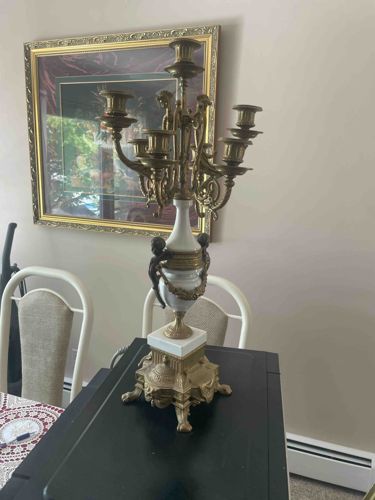
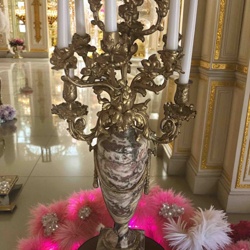
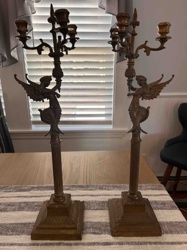
This is a large, ornate multi-arm candelabra, likely designed for formal settings. The construction appears to be a combination of materials, primarily featuring patinated bronze or brass for the majority of the decorative elements and candleholders, contrasted with a central column of white marble or alabaster. The metal components exhibit a rich, aged golden-brown patina, suggesting considerable age. The candelabra boasts seven candleholders, arranged in a tiered fashion, with the central holder being the tallest, surrounded by six others branching off from the main stem on scrolling arms. Decorative elements are abundant, including acanthus leaf motifs, floral elements, and intricate scrollwork on the candle arms and the base. A particularly notable feature is the pair of putti or cherubic figures, executed in a darker material (possibly patinated bronze or cast iron), flanking the white marble column, holding swags or garlands. The central white column is urn-shaped and rests on a square white marble plinth. The base is highly elaborate, crafted from the same patinated metal, featuring detailed relief work, possibly depicting more classical motifs, and supported by four distinct paw-like feet. The overall style suggests a Neoclassical or Empire period influence, possibly late 19th to early 20th century. Visible condition issues include expected wear and surface grime consistent with age, particularly on the metallic elements, which show some areas of darkening and possible tarnishing. There are no obvious signs of major damage or repair, though a closer inspection would be needed to confirm the integrity of all attachments. The craftsmanship appears to be of high quality, indicative of a substantial decorative piece intended to impress.
AI Appraisal Report
I have examined the provided image of this Seven-Light Candelabra with Putti and Marble Elements. Based on the visual evidence, it appears to be a substantial decorative piece, likely from the late 19th to early 20th century, consistent with Neoclassical or Empire influences. The construction from patinated bronze/brass and white marble is typical of high-quality decorative arts from this period. The rich patina and intricate detailing, including acanthus leaves, scrollwork, and putti figures, suggest skilled craftsmanship.
From the image, the condition appears good for its age, showing expected wear, surface grime, and darkening/tarnishing on the metallic elements. I do not observe any obvious major damage or repairs, but a hands-on inspection would be crucial to confirm the integrity of all attachments and assess for any subtle restorations or hairline cracks in the marble. The lack of visible major damage positively impacts its value.
Market conditions for such ornate, period candelabra remain stable, particularly for pieces with good scale and intricate detailing. Comparables in this style and quality range typically fetch good prices in decorative arts auctions and specialized antique markets. Pieces featuring white marble elements and cherubic figures tend to be particularly desirable. While not exceptionally rare, a candelabra of this size and apparent quality holds steady demand among collectors of classical decorative arts and interior designers.
Factors significantly impacting value include the overall craftsmanship, the absence of significant damage, the appeal of the specific design, and the quality of the patination. The seven-light configuration also adds to its impressiveness and value. Without physical examination, I cannot definitively verify the material composition beyond visual assessment (e.g., distinguishing between bronze and brass, or type of marble). True authenticity and specific attribution would require in-person examination, including detailed inspection of construction techniques, potential maker's marks not visible in the image, and analysis of provenance documentation. Scientific testing, such as metallurgy analysis, would be needed for definitive material identification if provenance is lacking. My appraisal is based solely on the visual information provided.