These notes were written by the person who submitted this item. Appraiser.AI has not verified them, and the AI's identification and estimate may rely on them.
AI Estimated Value
Not an official valuation
$1,800 - $2,800
AI estimate as of August 26, 2025 · verify with a professional before acting
AI-Generated · Verify before acting
Everything on this page is generated by AI for informational purposes only. AI can make mistakes — the AI may misidentify items or misattribute them (artist, maker, brand, designer, origin, era). This is not an official valuation and should not be used for insurance, sale, tax, estate, legal, or lending purposes — or any decision requiring a certified appraisal. It is not an authoritative claim about any person, brand, or rights holder — do not share or rely on it as a factual statement about a third party. Always consult qualified professionals before making financial decisions.
This analysis also relies on unverified notes provided by the user, which may be incomplete or inaccurate and could affect the result.
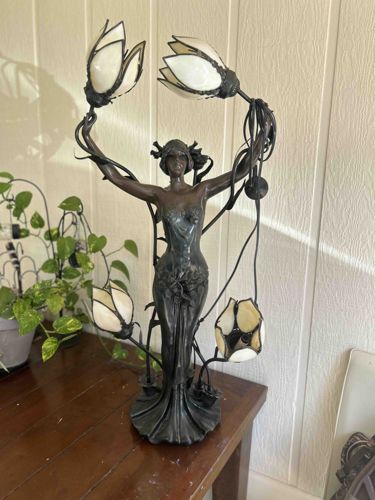
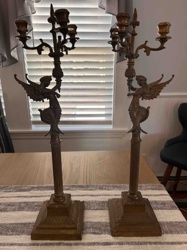
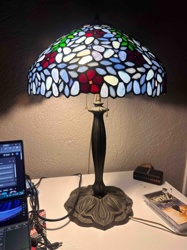
This is a substantial and ornate figural table lamp, likely crafted from cast metal with a bronze or dark patinated finish, given its "very heavy" nature. The central element is a female figure, possibly a nymph or a classical deity, depicted in an elegant, flowing gown with arms raised, creating a dynamic pose. Her hair appears stylized, perhaps with elements suggestive of leaves or vines. Surrounding the figure and integrated into the design are numerous 'lily' or 'tulip' shaped lampshades made of stained glass. There are at least five visible shades: two large ones extending upwards from her raised arms, two smaller ones positioned lower, and one more distinctive, slightly more open flower-shaped shade near the base on the right side. The glass sections within these shades are predominantly opaque white or cream-colored, with some possibly having subtle yellow or amber hues, joined by dark lead or copper foil lines, typical of Tiffany-style construction. The electrical wiring is visibly integrated into the sculptural elements, resembling vines or tendrils growing around the figure and supporting the lamp heads. The base of the lamp is wide and fluted, providing stability for the heavy top structure. The overall aesthetic strongly suggests an Art Nouveau influence, characterized by its organic forms, natural motifs, and emphasis on the female figure. The dark patina of the metalwork shows some wear and dust, consistent with age and use, but no significant damage or repairs are immediately apparent. The craftsmanship appears detailed, particularly in the rendering of the figure's drapery and the intricate metalwork simulating vines. Without maker's marks, estimation of its exact age is difficult, but it aligns with early 20th-century decorative styles. Its weight indicates quality material and construction.
AI Appraisal Report
Upon examining the provided image and information, this Art Nouveau-style figural table lamp with stained glass shades presents as a robust and ornate piece. The "very heavy" description supports the likelihood of quality cast metal construction, possibly bronze or a patinated spelter. The overall condition appears consistent with age and use; I note some surface wear and dust on the dark patina, but no immediate signs of significant damage, cracks, or repairs to either the metalwork or the stained glass elements. The intricate detailing of the female figure and the integrated 'vine' wiring are well-executed, typical of the Art Nouveau aesthetic from the turn of the 20th century. Authenticity, based solely on visual inspection, points strongly to a good-quality period-inspired piece or a later reproduction of similar caliber. Without maker's marks, definitive attribution to a specific workshop like Tiffany Studios or Handel is impossible.
Market conditions for Art Nouveau lighting, particularly those with stained glass, remain stable with consistent demand for well-preserved, aesthetically pleasing examples. Comparables for unsigned, high-quality figural lamps of this style can vary widely. While this lamp exhibits many characteristics of early 20th-century design, the absence of marks and the challenges of verifying material consistency from an image alone mean it cannot be definitively identified as a period original from a prominent maker. If it were authenticated as a period piece by a top-tier maker, the value would be substantially higher. For full authentication, I would require a physical examination to test the metal composition, inspect internal wiring for originality and safety, and meticulously check for any hidden marks or repair work. Provenance documentation would also be crucial to establish a concrete history.
Considering these factors, particularly the lack of identification and the limitations of image-only appraisal, I am assessing its value as a decorative, well-made Art Nouveau-style figural lamp.