These notes were written by the person who submitted this item. Appraiser.AI has not verified them, and the AI's identification and estimate may rely on them.
AI Estimated Value
Not an official valuation
$600 - $900
AI estimate as of August 29, 2025 · verify with a professional before acting
AI-Generated · Verify before acting
Everything on this page is generated by AI for informational purposes only. AI can make mistakes — the AI may misidentify items or misattribute them (artist, maker, brand, designer, origin, era). This is not an official valuation and should not be used for insurance, sale, tax, estate, legal, or lending purposes — or any decision requiring a certified appraisal. It is not an authoritative claim about any person, brand, or rights holder — do not share or rely on it as a factual statement about a third party. Always consult qualified professionals before making financial decisions.
This analysis also relies on unverified notes provided by the user, which may be incomplete or inaccurate and could affect the result.
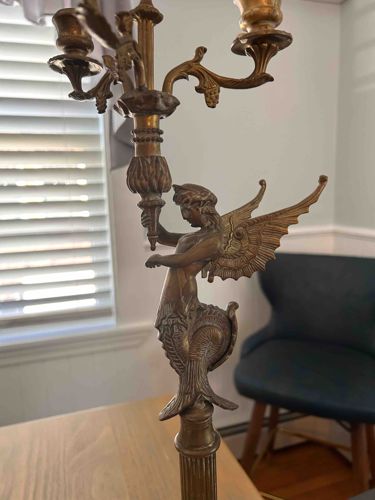
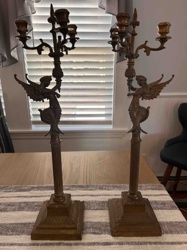
This is a bronze or brass candelabrum, likely designed for three candles (a two-light configuration appears visible, plus the central column). The piece is characterized by an ornate design, with the central shaft decorated with classical motifs. The most prominent feature is a winged figure, resembling a putto or an angel, holding what appears to be a torch. This figure has a human torso and head, with large, detailed wings, and a lower body that transitions into a scaly, fish-like tail or stylized drapery, suggesting a possible merman or sea creature motif. The material exhibits a dark, aged patina, consistent with bronze or heavily aged brass, with some lighter, polished areas suggesting handling or previous cleaning. The casting appears to be of good quality, showing detailed features on the figure's face, hair, wings, and the individual scales of the tail. The arms extending to hold the candle cups are elegantly curved and feature stylized leaf or vine embellishments. Each candle cup has a fluted or ruffled rim. Visible condition issues include typical surface wear and an uneven patina, which is common for antique or vintage metal pieces and contributes to its character. There are no obvious signs of major damage, repairs, or missing components from the visible sections. The style and intricate detailing suggest a period revival piece, possibly late 19th or early 20th century, drawing inspiration from classical or mythological themes. The craftsmanship indicates it was a decorative, perhaps even luxury, item intended for display in a formal setting.
AI Appraisal Report
Upon my virtual examination of the provided image and the owner's details, Vittorio Alinari, I assess this Figural Bronze/Brass Candelabrum. The piece presents as a decorative arts item, likely a candelabrum, exhibiting characteristics consistent with bronze or heavily aged brass. The casting quality appears good, with detailed features on the winged figure, suggesting a late 19th or early 20th-century period revival piece, drawing from classical or mythological themes. The patina is suitably aged for its presumed vintage, contributing to its character. I observe typical surface wear and an uneven patina, common for antique metalware. Crucially, there are no obvious signs of major damage or missing components from the visible sections.
In terms of market conditions, comparable ornate bronze or brass candelabra of similar age and quality tend to perform steadily. While not exceptionally rare, pieces with distinct figural elements like this winged torchbearer do attract collector interest. The detailed craftsmanship indicates it was originally a luxury item, enhancing its decorative appeal and contributing to demand. Its aesthetic aligns with traditional home decor, maintaining a consistent demand in the secondary market.
My valuation is primarily impacted by its good visual condition, intricate design, and the appealing aged patina. However, it is essential to note the limitations of this appraisal. Authenticity verification is inherently restricted to visual examination of images. A definitive confirmation of the material (bronze vs. brass), casting method, and precise age would necessitate in-person examination, including tactile assessment and possibly elemental analysis. Furthermore, provenance documentation would significantly enhance confidence in its history and origin. Without physical inspection, I cannot rule out the possibility of a later reproduction, though its current appearance suggests authenticity.