AI estimate as of November 4, 2025 · verify with a professional before acting
AI-Generated · Verify before acting
Everything on this page is generated by AI for informational purposes only. AI can make mistakes — the AI may misidentify items or misattribute them (artist, maker, brand, designer, origin, era). This is not an official valuation and should not be used for insurance, sale, tax, estate, legal, or lending purposes — or any decision requiring a certified appraisal. It is not an authoritative claim about any person, brand, or rights holder — do not share or rely on it as a factual statement about a third party. Always consult qualified professionals before making financial decisions.
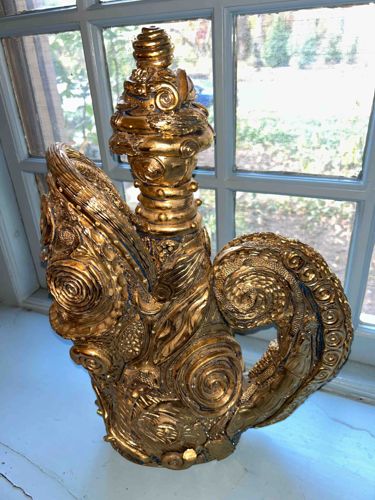
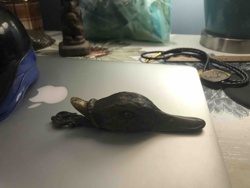
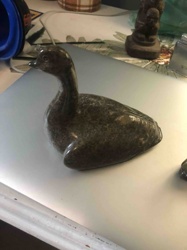
This appears to be an abstract sculpture or decorative art object, characterized by its heavily textured and ornate surface finished in a metallic gold or gilt color. The primary material seems to be a composite or molded substance, possibly resin or a ceramic, given the intricate detailing and the relative uniformity of the surface texture. The construction is elaborate, featuring a prominent central cylindrical element from which various scroll-like and organic, wavy forms emanate. These forms are densely covered with a variety of raised patterns, including tight spirals, concentric circles, stippling, and wave-like textures, creating a rich, almost baroque, visual effect. The overall shape is irregular and asymmetric, suggesting a free-form artistic expression rather than a functional design. One notable feature is a finial-like element at the top, composed of stacked, tapering spirals, reminiscent of a screw or a stylized beehive. Below this, the cylindrical neck features small, raised circular dots or beads arranged in horizontal rows. The coloration is predominantly a bright, reflective gold, showing some variations in tone that highlight the sculptural depth and texture, with darker recesses suggesting antique or aged gilt. There are no obvious maker's marks or signatures visible in the image. The style leans towards fantasy, organic abstraction, or possibly 'steampunk' aesthetics due to its combination of mechanical-looking elements (like the screw-like finial) and fluid, naturalistic forms. The condition appears good, with no obvious signs of significant damage such as chips, cracks, or flaking of the gilt finish, though a natural patina or subtle wear might be present upon closer inspection. The craftsmanship is highly detailed, indicative of a piece that required careful sculpting and finishing.
AI Appraisal Report
Based on my visual examination of the provided image, this Abstract Gilt Scrolled Sculpture presents as a decorative art object with significant visual appeal. The condition appears to be good; I observe no obvious chips, cracks, or significant loss to the gilt finish. The intricate detailing and textured surface are well-preserved, suggesting careful handling or display. Without physical inspection, I cannot confirm authenticity beyond what appears to be a commercially produced decorative item. There are no visible artist's signatures or maker's marks that would indicate a known artist or workshop, which limits its potential as a fine art piece.
The market for abstract decorative sculptures, particularly those with a gilt finish and ornate detailing, is generally stable. Comparable items in the secondary market, often found in home decor stores or online marketplaces, typically range from $150 to $700 depending on size, actual material (e.g., resin vs. bronze), and perceived intricacy. This specific piece’s elaborate design and reflective finish contribute positively to its aesthetic value. Demand for such pieces is driven primarily by interior design trends rather than art collecting. Its rarity is difficult to quantify without knowledge of its provenance or manufacturer; however, mass-produced decorative items of this nature are not typically rare.
Factors impacting value include its attractive finish and detailed craftsmanship. However, the lack of an identifiable artist, origin, or material specification limits its value as a collectible antique or fine art piece. The primary limitation in authenticating this item is the reliance on an image alone. A full authentication would require in-person examination to assess the exact material composition, weight, and detect any subtle repairs or manufacturing flaws. Provenance documentation could shed light on its history and origin, potentially elevating its value if linked to a significant designer or period. Scientific testing could verify material composition if needed. Given these limitations, I assess the appraisal value to be in the range of $300-500, reflecting its decorative merit and good condition as a visually striking object.