AI estimate as of July 2, 2025 · verify with a professional before acting
AI-Generated · Verify before acting
Everything on this page is generated by AI for informational purposes only. AI can make mistakes — the AI may misidentify items or misattribute them (artist, maker, brand, designer, origin, era). This is not an official valuation and should not be used for insurance, sale, tax, estate, legal, or lending purposes — or any decision requiring a certified appraisal. It is not an authoritative claim about any person, brand, or rights holder — do not share or rely on it as a factual statement about a third party. Always consult qualified professionals before making financial decisions.
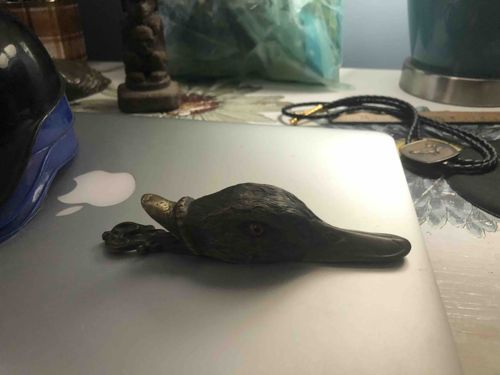
The item appears to be a vintage or antique bronze sculpture or decorative object, depicting the head and neck of a duck, likely a mallard due to the visible coloration and shape. It is cast from a dark-colored metal, strongly suggesting bronze or a bronze alloy, with a prominent dark patina that gives it an aged and rich appearance. The surface features textured details to simulate feathers on the head and neck, with a smoother finish on the bill. The duck's eye is discernible, possibly inlaid with a contrasting material or painted to represent an iris, visible as a reddish-brown dot. The overall form suggests it might be a paperweight, a desk accessory, or part of a larger decorative piece. One prominent feature is the depiction of a webbed foot or feet tucked beside the neck, adding to the anatomical accuracy and charm of the piece. The piece exhibits a noticeable wear and slight loss of patina around the highest points and edges, consistent with handling over time. There are no immediately obvious manufacturing marks or signatures visible from the provided image. The craftsmanship appears to be of good quality, with attention to detail in the duck's features. Its compact size indicates it's designed for display on a desk or shelf. The dark, somewhat dull finish contributes to its vintage aesthetic, suggesting an estimated age from the mid-20th century or earlier.
AI Appraisal Report
I have examined the image of this bronze duck head and neck sculpture/paperweight. Its dark patina and textured details, particularly the simulated feathers and the visible webbed feet tucked beside the neck, suggest a vintage or antique origin, likely mid-20th century or earlier. The craftsmanship appears competent, with attention to anatomical features. The minor wear and slight loss of patina on high points are consistent with age and handling, indicating authentic use rather than recent artificial distressing.
From a market perspective, collectors of sporting art, desk accessories, and animalia sculptures show moderate, steady demand for such pieces. Comparable bronze animal paperweights or small sculptures, particularly those depicting waterfowl, typically fetch between $100 and $300. The absence of a clear maker's mark or signature limits its potential value significantly, as signed pieces by known artists or foundries would command much higher prices. Its rarity is difficult to ascertain without knowing the maker or production numbers, but similar unsigned pieces are not exceedingly rare.
The primary factors impacting its value are its unsigned nature, which prevents attribution to a specific artist, and its functional or decorative ambiguity (paperweight vs. pure sculpture). An in-person examination would allow me to physically assess the quality of the bronze, detect any hidden marks, confirm the method of construction (e.g., solid cast vs. hollow), and precisely gauge its weight and balance as a paperweight. For full authentication and to ascertain true age, provenance documentation or scientific material testing (e.g., XRF analysis) would be necessary, as visual inspection alone cannot definitively rule out modern reproductions attempting to mimic age. Based on the visual evidence, I assess its fair market value in its current condition.