These notes were written by the person who submitted this item. Appraiser.AI has not verified them, and the AI's identification and estimate may rely on them.
AI Estimated Value
Not an official valuation
$5-10
AI estimate as of November 10, 2025 · verify with a professional before acting
AI-Generated · Verify before acting
Everything on this page is generated by AI for informational purposes only. AI can make mistakes — the AI may misidentify items or misattribute them (artist, maker, brand, designer, origin, era). This is not an official valuation and should not be used for insurance, sale, tax, estate, legal, or lending purposes — or any decision requiring a certified appraisal. It is not an authoritative claim about any person, brand, or rights holder — do not share or rely on it as a factual statement about a third party. Always consult qualified professionals before making financial decisions.
This analysis also relies on unverified notes provided by the user, which may be incomplete or inaccurate and could affect the result.
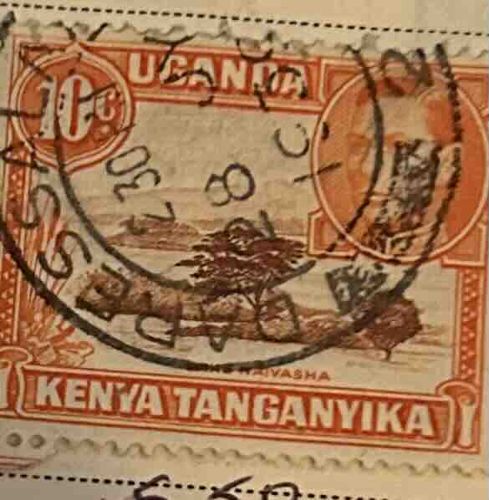
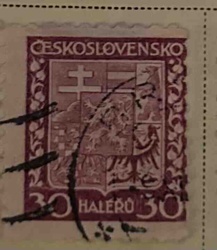
This item is a vintage postage stamp, likely from the mid-20th century, issued for the British East African territories of Kenya, Uganda, and Tanganyika. The stamp is rectangular in shape with perforated edges, indicative of its philatelic purpose. The primary color scheme consists of a reddish-orange border and text against a lighter, possibly ochre or beige, background for the central image. The denomination '10 C' is prominently displayed in the upper left corner within a circular or oval cartouche. The word 'UGANDA' is visible at the top center, and 'KENYA TANGANYIKA' is located along the bottom border, suggesting a joint issue for these colonial entities. The central vignette depicts a landscape scene, possibly featuring Lake Naivasha, given a partially visible 'NAIVASHA' at the bottom of the central illustration. The scene includes trees, possibly acacias, and a body of water with what appear to be small islands or landforms. In the upper right, within another circular frame, there is a portrait, potentially of a monarch or dignitary, though it is heavily obscured by a postmark. The stamp has been used, as evidenced by a prominent circular postmark with a date '8 7 30' (August 7, 1930) and an illegible location name, possibly 'EN' or 'SS'. The postmark's lines extend across much of the stamp, affecting the visibility of some details. Despite the postmark, the colors appear relatively vibrant, and the perforations seem intact, though a slight crease or imperfection might be present near the top-right edge. The overall condition suggests moderate circulation, consistent with a used stamp of this age. The printing quality appears to be standard for colonial postal issues of the era.
AI Appraisal Report
I have examined the provided image and description of the Kenya, Uganda, and Tanganyika 10 Cents stamp. This stamp appears to be an authentic issue from the British East African territories, dating to the period suggested by the 1930 postmark. The design, including the prominent '10 C' denomination, the 'Kenya Uganda Tanganyika' inscription, and the scenic vignette, is consistent with known issues for these colonial entities.
Regarding its condition, the stamp is clearly used, evidenced by the heavy circular postmark dated '8 7 30'. While the colors appear relatively vibrant for its age, the postmark significantly obscures the central portrait and parts of the design, which reduces its aesthetic appeal and, consequently, its value. The description mentions 'intact' perforations, which is a positive, but also notes a 'slight crease or imperfection near the top-right edge,' further impacting its condition grade. Used stamps of this era are typically valued higher if they have light, neat cancellations that do not deface the central design, or if they are uncancelled (mint).
In terms of market conditions, stamps from Kenya, Uganda, and Tanganyika are generally popular with collectors of British Commonwealth and African philately. However, this specific issue, particularly in used condition with a heavy postmark, is not considered rare. Comparables show that average used examples with heavy cancellations typically fetch modest prices. Demand exists, but it is not for heavily franked examples. The 'Japan Stamp' owner detail doesn't impact the stamp itself but could be part of provenance documentation.
My appraisal is limited by the fact that I have only examined an image. A definitive assessment of authenticity, paper type, watermarks, gum condition (if mint), and precise perforation count would require a physical, in-person examination. This would also allow for a more accurate assessment of any minor imperfections not clearly visible in the image, such as thinning, repairs, or more subtle creasing. Without physical inspection, I cannot confirm the integrity of the paper or detect any potential alterations or repairs.