These notes were written by the person who submitted this item. Appraiser.AI has not verified them, and the AI's identification and estimate may rely on them.
AI Estimated Value
Not an official valuation
$400 - $800
AI estimate as of August 8, 2025 · verify with a professional before acting
AI-Generated · Verify before acting
Everything on this page is generated by AI for informational purposes only. AI can make mistakes — the AI may misidentify items or misattribute them (artist, maker, brand, designer, origin, era). This is not an official valuation and should not be used for insurance, sale, tax, estate, legal, or lending purposes — or any decision requiring a certified appraisal. It is not an authoritative claim about any person, brand, or rights holder — do not share or rely on it as a factual statement about a third party. Always consult qualified professionals before making financial decisions.
This analysis also relies on unverified notes provided by the user, which may be incomplete or inaccurate and could affect the result.
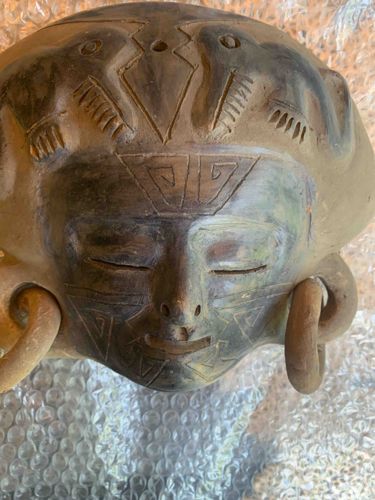
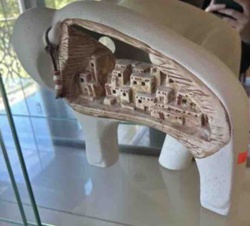
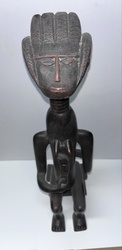
The item is a ceramic effigy vessel, likely a jar or urn, shaped to depict a human or anthropomorphic face, possibly of indigenous origin. It is crafted from unglazed, earthenware clay, exhibiting a range of natural earthy tones from warm brown to darker, almost black, areas, especially within the facial features and incised patterns, which suggest deliberate staining or firing techniques. The overall form is rounded and substantial, indicative of a vessel. The face features closed eyes, a subtle smile, and a prominent nose. Distinctive decorative elements include a patterned headband or headdress with what appear to be two stylized bird or animal heads facing towards the center, flanking a central geometric motif. Below this, on the forehead, is a triangular, maze-like or labyrinthine pattern. Further geometric designs, possibly representing scarification or tribal markings, are incised on the cheeks and below the mouth. Two large, circular loops, resembling ear ornaments or handles, protrude from either side of the head. The surface shows a natural matte finish, with some areas appearing smoother due to handling or wear, and slight discolorations that could be from age or original firing processes. No obvious cracks or significant chips are visible, but the clay exhibits a rustic, hand-built quality, contributing to its aged appearance. The craftsmanship suggests a folk art or ethnographic piece, emphasizing symbolic representation over precise realism.
AI Appraisal Report
Upon examining the images provided of this anthropomorphic effigy vessel, my assessment identifies it as a compelling piece of folk art or ethno-historical pottery. The hand-built earthenware construction, incised geometric patterns, and stylized facial features are consistent with various pre-Columbian or historic indigenous ceramic traditions, particularly from Mesoamerica or South America, such as Chimu, Moche, or possibly from cultures in the Southeastern United States. The condition appears to be good for an artifact of its potential age, with a stable structure and clear details, though the finish shows expected wear and firing variations. The market for authentic pre-Columbian and tribal artifacts is strong, but value is critically dependent on authenticity and provenance. Similar, authenticated ceremonial vessels can command prices ranging from the low thousands to tens of thousands of dollars, depending on culture, rarity, and artistic merit. Conversely, the market is saturated with well-made replicas, which carry decorative value only. The primary factor impacting this item's value is its authenticity. Without physical examination, I cannot definitively confirm its age or origin. A full appraisal would require thermoluminescence (TL) testing to date the firing of the clay, an examination for modern tool marks, and a thorough review of its collecting history (provenance). Without such verification, the piece must be valued cautiously as a decorative item of unknown origin.