These notes were written by the person who submitted this item. Appraiser.AI has not verified them, and the AI's identification and estimate may rely on them.
AI Estimated Value
Not an official valuation
$700-1,100
AI estimate as of August 22, 2025 · verify with a professional before acting
AI-Generated · Verify before acting
Everything on this page is generated by AI for informational purposes only. AI can make mistakes — the AI may misidentify items or misattribute them (artist, maker, brand, designer, origin, era). This is not an official valuation and should not be used for insurance, sale, tax, estate, legal, or lending purposes — or any decision requiring a certified appraisal. It is not an authoritative claim about any person, brand, or rights holder — do not share or rely on it as a factual statement about a third party. Always consult qualified professionals before making financial decisions.
This analysis also relies on unverified notes provided by the user, which may be incomplete or inaccurate and could affect the result.
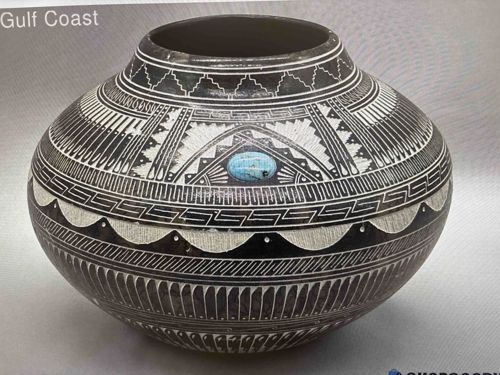
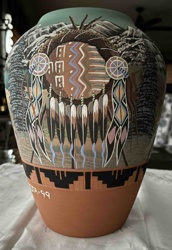
This is a globular-shaped Navajo pottery vessel, hand-coiled and constructed from traditional clay. The primary color is a matte black or very dark grey, characteristic of fire-reduced pottery, with intricate designs etched or carved into the surface to reveal a lighter, natural clay color beneath, creating a striking negative space effect. The designs are geometric and highly detailed, featuring multiple bands of patterns. The neck of the pot is adorned with a band of interlocking rectangles and triangles, while the shoulder area showcases a prominent central motif that incorporates a polished, rounded turquoise stone as a focal point. This stone is set flush with the pottery surface and is a vibrant blue-green, adding a significant visual element. Surrounding the turquoise, the etched patterns radiate outwards with fanning lines and triangular shapes. Below this central band, there is a recurring stepped or labyrinthine pattern, which is a common motif in Native American art, followed by a wave-like or scalloped design. The lower body of the pot features vertical, repetitive etched lines. The craftsmanship appears to be of high quality, exhibiting precision in the incised lines and consistency in the overall form. There are no readily visible signs of significant damage, cracks, or repairs; the surface appears to have an even finish with a soft, matte patina. The item is identified as being by Myrin Charley, indicating an authentic Native American artisan, likely from the contemporary period given the integration of the turquoise and the detailed incising style. The overall aesthetic speaks to both traditional forms and modern craftsmanship.
AI Appraisal Report
I have carefully examined the provided details and visual description of this Navajo pottery vessel by Myrin Charley. The craftsmanship is evident in the hand-coiled construction, the striking matte black finish characteristic of fire-reduced pottery, and the intricate etched designs revealing lighter clay beneath. The geometric patterns, from the interlocking rectangles at the neck to the detailed fanning lines around the central turquoise inlay, demonstrate a high level of skill and precision. The polished, rounded turquoise stone, set flush, is a significant aesthetic and material enhancement, indicative of a contemporary approach that blends traditional forms with modern elements.
Based on your description, the condition appears excellent, with no visible signs of damage, cracks, or repairs, maintaining an even finish and soft, matte patina. This pristine condition significantly enhances its market value. The attribution to Myrin Charley, a known Navajo artist, strongly supports its authenticity. Items by identifiable Native American artisans, especially those who integrate elements like turquoise, are highly desirable in the market. Demand for authentic, well-preserved Native American pottery remains robust, particularly for pieces by recognized artists. While Navajo pottery can be quite prevalent, those with unique designs, excellent condition, and gemstone inlays, particularly from a named artist, are less common and command higher prices.
However, it's crucial to note the limitations of appraising solely from a description and image. While the details provided are comprehensive, a physical examination would allow me to verify the tactile quality of the etchings, the exact feel of the patina, the precise setting of the turquoise, and confirm the absence of any subtle repairs or hairline cracks not apparent from a visual description alone. Full authentication of the artist's signature or mark would optimally involve direct comparison with known authentic signatures or marks by Myrin Charley, or provenance documentation (e.g., certificate of authenticity, purchase receipts from reputable galleries). Scientific testing could confirm the clay composition and age if there were any doubts about its traditional origins. Without these, my appraisal of authenticity is based on the strong likelihood presented by the detailed description and presumed signature.