AI estimate as of November 11, 2025 · verify with a professional before acting
AI-Generated · Verify before acting
Everything on this page is generated by AI for informational purposes only. AI can make mistakes — the AI may misidentify items or misattribute them (artist, maker, brand, designer, origin, era). This is not an official valuation and should not be used for insurance, sale, tax, estate, legal, or lending purposes — or any decision requiring a certified appraisal. It is not an authoritative claim about any person, brand, or rights holder — do not share or rely on it as a factual statement about a third party. Always consult qualified professionals before making financial decisions.
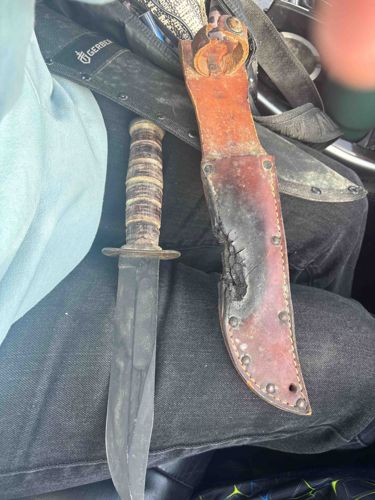
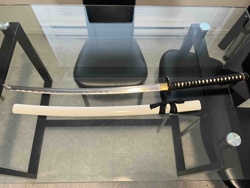
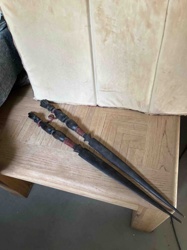
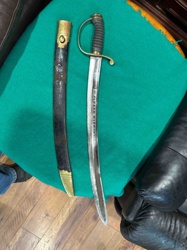
This item appears to be a vintage field knife, likely from the mid-20th century, accompanied by its original leather sheath. The knife features a stacked leather washer handle, typical of many combat or utility knives from that era, such as those used by military personnel. The handle shows significant wear, with darkening and scuffing consistent with age and extensive use. The blade is a fixed blade design, seemingly made of carbon steel, exhibiting a dark patina, scratches, and some surface corrosion, indicating lack of recent maintenance or prolonged exposure to elements. It has a slightly recurved profile with a noticeable clip point or spear point at the tip, and a fuller (blood groove) runs along the center of the blade, enhancing its rigidity. A simple metal crossguard separates the blade from the handle, showing similar signs of age and wear as the blade. The leather sheath is a separate, distinct component crafted from thick, reddish-brown leather, hand-stitched along the edges with what appears to be yellow or off-white thread. It features a belt loop at the top, secured by a metal snap, and a retention strap that would typically secure the handle. The most prominent condition issue on the sheath is a significant area of damage or charring near the mouth, which appears to be either burnt or heavily abraded, exhibiting a dark, almost black, rough texture. Several metal rivets are present along the perimeter of the sheath and near the tip, likely for structural reinforcement. The sheath itself shows overall wear, scuffs, and discoloration, but the stitching appears largely intact despite the damage. The combined condition suggests heavy use and some form of accidental damage to the sheath.
AI Appraisal Report
This vintage field knife, with its stacked leather washer handle and carbon steel blade, appears to be a utilitarian piece from the mid-20th century. The wear on the handle and the patina, scratches, and corrosion on the blade are consistent with significant age and use. The fuller suggests a design emphasizing rigidity. The accompanying leather sheath, despite its considerable damage—specifically the burnt or heavily abraded area near the mouth—is likely original and shows hand-stitching and metal rivets for reinforcement. Authenticity seems generally consistent with a period utility knife, though definitive confirmation of specific maker or exact age would require in-person examination.
Market conditions for vintage utility or combat knives vary significantly based on manufacturer, historical significance, and condition. While there is demand for such items among collectors, the heavily used condition of the knife and the significant damage to the sheath detract from its overall value. The corrosion on the blade and the sheath damage are major negative factors. Without a known maker's mark or specific historical provenance, its rarity is limited to that of a common period utility knife.
My appraisal is based solely on the provided image. A thorough in-person examination would be crucial to assess the blade's integrity, determine specific steel composition, evaluate the extent of the sheath's damage, and search for any hidden maker's marks or stamps that could significantly influence value. Provenance documentation, if available, would also be essential for a more precise valuation and to confirm any historical associations.