Pair of African Maasai Seme Short Swords
Ethnographic Weaponry and Artifacts

Pair of African Maasai Seme Short Swords

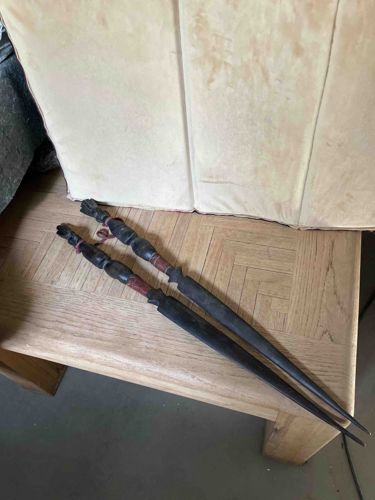
This pair of traditional short swords, commonly known as Seme (or Sime), originates from East Africa, typically associated with the Maasai or Samburu people. Each sword is approximately 18 to 22 inches in length, featuring a leaf-shaped, double-edged blade forged from carbon steel. The blades have a distinct central rib and taper to a sharp point, characteristic of high-quality hand-forged craftsmanship. The handles are constructed without a crossguard, providing a seamless transition from the grip to the blade. The hilts appear to be made of carved wood or heavy leather wrapping, decorated with traditional red-pigmented sections and bulbous, ribbed carvings that ensure a secure grip. The coloring suggests the use of organic dyes or ochre, which is common in East African tribal weaponry. Notable condition issues include a heavy surface patina and oxidation on the metal blades, consistent with mid-20th-century age rather than modern souvenir production. There is visible wear on the handle pigments and slight scuffing indicative of authentic use or long-term storage. The lack of commercial maker's marks supports the item's origin as a piece of ethnographic utility or ceremonial gear rather than a mass-market reproduction. The overall construction exhibits the robust, functional aesthetic of traditional African smithing.
Estimated Value

$350 - $550

Basic Information

Category

Ethnographic Weaponry and Artifacts

Appraised On

February 11, 2026

Estimated Value

$350 - $550

Item Description

This pair of traditional short swords, commonly known as Seme (or Sime), originates from East Africa, typically associated with the Maasai or Samburu people. Each sword is approximately 18 to 22 inches in length, featuring a leaf-shaped, double-edged blade forged from carbon steel. The blades have a distinct central rib and taper to a sharp point, characteristic of high-quality hand-forged craftsmanship. The handles are constructed without a crossguard, providing a seamless transition from the grip to the blade. The hilts appear to be made of carved wood or heavy leather wrapping, decorated with traditional red-pigmented sections and bulbous, ribbed carvings that ensure a secure grip. The coloring suggests the use of organic dyes or ochre, which is common in East African tribal weaponry. Notable condition issues include a heavy surface patina and oxidation on the metal blades, consistent with mid-20th-century age rather than modern souvenir production. There is visible wear on the handle pigments and slight scuffing indicative of authentic use or long-term storage. The lack of commercial maker's marks supports the item's origin as a piece of ethnographic utility or ceremonial gear rather than a mass-market reproduction. The overall construction exhibits the robust, functional aesthetic of traditional African smithing.
Get Your Items Appraised

Instant estimates of your treasures with AI-powered instant appraisals

Browse More Appraisals