These notes were written by the person who submitted this item. Appraiser.AI has not verified them, and the AI's identification and estimate may rely on them.
AI Estimated Value
Not an official valuation
$40-70
AI estimate as of December 6, 2025 · verify with a professional before acting
AI-Generated · Verify before acting
Everything on this page is generated by AI for informational purposes only. AI can make mistakes — the AI may misidentify items or misattribute them (artist, maker, brand, designer, origin, era). This is not an official valuation and should not be used for insurance, sale, tax, estate, legal, or lending purposes — or any decision requiring a certified appraisal. It is not an authoritative claim about any person, brand, or rights holder — do not share or rely on it as a factual statement about a third party. Always consult qualified professionals before making financial decisions.
This analysis also relies on unverified notes provided by the user, which may be incomplete or inaccurate and could affect the result.
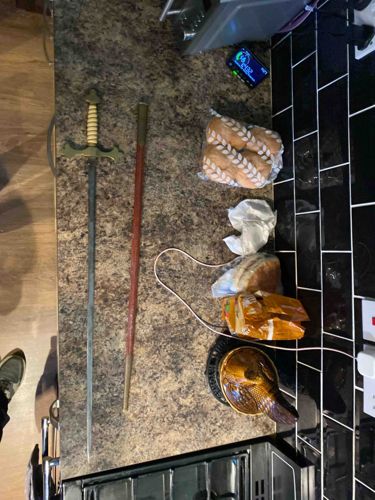
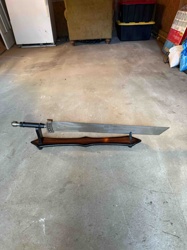
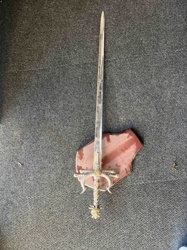
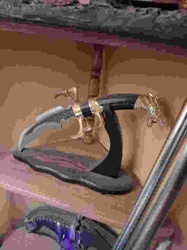
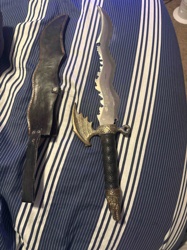
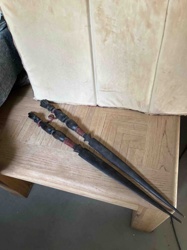
This item is a decorative sword, likely intended for display, costume, or theatrical use, rather than a functional weapon. It consists of two main parts: the sword itself and its accompanying scabbard. The sword features a straight, double-edged blade that appears to be constructed from steel, exhibiting a dull, non-reflective gray finish, suggesting it may be unsharpened or have a patinated surface. There are visible signs of wear and possibly some light surface corrosion or discoloration along the blade. The hilt is composed of a brass or brass-toned metal guard and pommel. The guard is a traditional cruciform style, with slightly flared quillons that show some decorative etching or casting details. The grip is wrapped with what appears to be a light-colored material, possibly a synthetic cord or plastic, designed to mimic a more historical wrapping, and it exhibits some minor scuffing or dirt. The pommel is a simple, rounded design. The overall length of the sword appears to be approximately 24-30 inches, placing it within the range of a short sword or long dagger. The scabbard is made of a reddish-brown material, likely wood or a synthetic core covered in vinyl or leather, with brass-toned fittings at the throat and chape. The scabbard shows some minor scuffs and marks, consistent with light handling and age. The construction suggests it's a reproduction rather than an authentic antique, possibly from the mid-to-late 20th century. The quality of craftsmanship, while adequate for a decorative piece, does not suggest high-end historical sword manufacturing.
AI Appraisal Report
Upon examining the provided image and information for this Decorative Medieval-Style Sword with Scabbard, I assess its condition as fair. The blade, likely steel, shows a dull, non-reflective gray finish with visible wear, suggesting it is unsharpened and possibly has surface corrosion or discoloration. The brass or brass-toned hilt components (guard and pommel) appear intact, with the guard exhibiting some decorative etching. The grip, seemingly a synthetic cord, shows minor scuffing. The reddish-brown scabbard, likely a synthetic material over a core, has brass-toned fittings and minor scuffs.
Authenticity-wise, this is clearly a decorative reproduction rather than a functional or antique weapon. The construction, materials (steel, brass, synthetic grip/scabbard), and overall finish are characteristic of items produced for display, costume, or theatrical use, likely from the mid-to-late 20th century.
Market conditions for such decorative pieces are generally modest. Comparables often include similar "wall-hanger" or costume swords found in online marketplaces, antique malls, or novelty shops. These items typically fetch low prices unless they are part of a recognized brand or have unique artistic merit, neither of which appears to be the case here. Demand for these decorative swords is moderate among collectors of fantasy items or those seeking props, but not strong enough to drive high values. Rarity is low; countless similar reproductions exist.
Factors significantly impacting value include the non-functional nature, common materials, and reproduction status. Without a known maker or unique historical association, its value remains primarily decorative.
Limitations in authenticity verification from images alone include the inability to definitively confirm the precise composition of the metals or synthetic materials, the exact quality of construction, or any hidden damage. An in-person examination would allow for tactile inspection of materials, closer assessment of any surface irregularities, verification of the blade's integrity (though not functional), and a more precise determination of manufacturing techniques. Provenance documentation could potentially add value if it linked the sword to a specific production company or use, but this is unlikely for such a piece. Scientific testing would be unnecessary for a modern decorative item.