AI estimate as of August 9, 2025 · verify with a professional before acting
AI-Generated · Verify before acting
Everything on this page is generated by AI for informational purposes only. AI can make mistakes — the AI may misidentify items or misattribute them (artist, maker, brand, designer, origin, era). This is not an official valuation and should not be used for insurance, sale, tax, estate, legal, or lending purposes — or any decision requiring a certified appraisal. It is not an authoritative claim about any person, brand, or rights holder — do not share or rely on it as a factual statement about a third party. Always consult qualified professionals before making financial decisions.
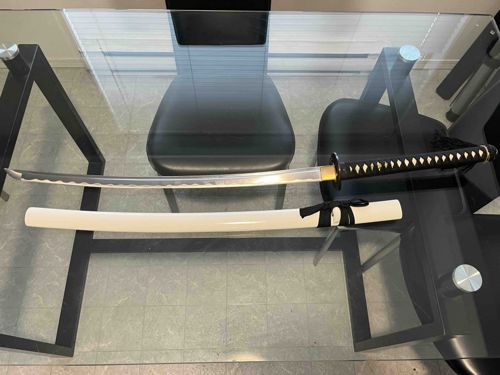
The item depicted appears to be a modern katana, a traditional Japanese sword, displayed alongside its scabbard (saya). The blade itself is polished metal, exhibiting a visible hamon, the temper line formed during the hardening process, which has a distinct wavy pattern (suguha or notare type). The blade shows good reflectivity and no obvious signs of significant rust or pitting, suggesting it is either well-maintained or relatively new. The tang (nakago) is not visible, so no maker's marks can be observed. The hilt (tsuka) is wrapped in what appears to be black ito (cord wrap) over a white samegawa (ray skin) underlay, with small, diamond-shaped openings revealing the white beneath. This wrapping style is characteristic of katanas. The pommel (kashira) is black, and the guard (tsuba) is a simple, round shape, appearing to be made of brass or a brass-colored metal, with no intricate designs immediately discernible. A gold-colored seppa (spacer) is visible between the tsuba and the habaki (blade collar). The white saya (scabbard) is unadorned and has a glossy finish, indicative of lacquer or a similar sealing material. A black sageo (cord) is tied around the kurikata (knob on the saya) in a decorative manner. The overall build suggests a functional reproduction or a decorative piece rather than an antique, given the clean lines and lack of significant patina or wear consistent with age. This piece appears to be in excellent condition with no visible damage.
AI Appraisal Report
Upon examining the provided image, I assess this katana as being in excellent condition, showing no visible signs of damage, rust, or significant wear. The clean lines, highly reflective blade with a distinct hamon, and the pristine saya suggest it is either a very well-maintained contemporary piece or relatively new. Authenticity, in the sense of being a historical or antique nihonto (Japanese sword), cannot be definitively confirmed from images alone. The construction, featuring a typical black ito wrap over white samegawa, a simple round tsuba, and polished saya, points towards a modern reproduction, likely made for display, martial arts practice (iaido/kendo), or as a functional cutting sword.
Market conditions for modern katanas are robust, with a wide range of pricing based on craftsmanship, materials (e.g., folded steel vs. mono-steel), and the reputation of the smith or manufacturer. This particular piece, while appearing well-made, lacks unique distinguishing features or intricate artistry that would place it in a higher tier. It seems comparable to mid-range production katanas available from reputable online vendors or specialty martial arts suppliers. Demand for such pieces is steady, driven by enthusiasts, martial artists, and collectors of decorative weaponry. Rarity is not a factor here; modern katana reproductions are widely produced.
Factors significantly impacting value include the visible quality of the hamon, the fit and finish of the tsuka and saya, and the overall aesthetic. Without being able to inspect the nakago (tang) for a mei (signature) or confirm the type of steel and forging process, I can only assess its visual appeal and apparent condition.
Limitations in authenticity verification are significant. A physical examination is crucial to determine if the blade is hand-forged, folded steel, differentially hardened, and to inspect the nakago for any markings. Provenance documentation would be essential to verify its history or maker. Scientific testing, such as material analysis, could confirm the type of steel and its metallurgical properties, which profoundly influence value and authenticity for a true antique or high-end modern piece. Hence, this appraisal is based solely on visual attributes in the provided image.