AI Appraisal Estimate

AI-generated estimates · not official valuations

From the user

What was submitted

Photo and notes provided by the user — not generated by AI

Submitted item photo
Submitted photo · May 18, 2026

User's notes

No additional notes provided.

AI analysis below

AI appraisal

AI analysis & estimate

AI-Generated · Verify before acting

Everything below is generated by AI for informational purposes only. AI can make mistakes — the AI may misidentify items or misattribute them (artist, maker, brand, designer, origin, era). This is not an official valuation and should not be used for insurance, sale, tax, estate, legal, or lending purposes — or any decision requiring a certified appraisal. It is not an authoritative claim about any person, brand, or rights holder — do not share or rely on it as a factual statement about a third party. Always consult qualified professionals before making financial decisions.

Read the full disclaimer

AI Identification

·Not independently authenticated·Verify before acting

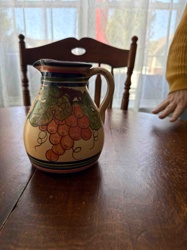
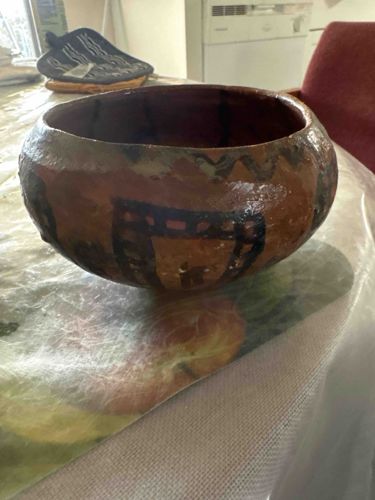
Hand-Painted Red Clay Ceramic Olla Bowl

Antique/Vintage Pottery and Ceramics

AI Estimated Value

·Not an official valuation·Verify before acting

$45.00 - $75.00

As of May 18, 2026

AI Item Analysis

·AI can make mistakes·Verify before acting
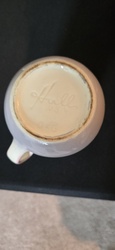
This item is a medium-sized, hand-built ceramic olla bowl, likely crafted from local red-earthenware clay. It features a bulbous, rounded body that tapers slightly toward an inward-curving rim. The exterior is decorated with folk-art style hand-painted motifs in dark brown or black pigments, including geometric ladder-like frames and a wavy 'serpent' or 'lightning' line around the top shoulder. The overall color palette is dominated by warm ochre, sienna, and terracotta tones, with a glossy glaze finish that appears unevenly applied, suggesting a artisanal or student-level production rather than high-end production. The construction shows irregular symmetry and a hand-pinched or coiled texture under the glaze, indicative of traditional pottery methods. Regarding condition, the piece shows significant signs of age and use, including surface crazing throughout the glaze, minor rim chips, and some fading of the painted pigments. There are visible dark scuffs and patches of patina that suggest the item may have been used or stored in a dusty environment. While no distinct maker's mark is visible from this angle, the style is reminiscent of 20th-century Southwest Native American inspired or Central American folk pottery. The craftsmanship is rustic, emphasizing utility and vernacular aesthetic over refined technical perfection.
AI Appraisal Report

·AI can make mistakes·Verify before acting
I have examined the provided description and visual characteristics of this hand-painted red clay olla. Based on my analysis, the piece is a 20th-century vernacular ceramic, likely produced within a Central American or Southwest-inspired folk art tradition. The construction displays a charming, rustic hand-built quality; however, the uneven glaze application and irregular symmetry suggest it is a decorative souvenir or student-level work rather than a museum-quality piece by a master potter. The condition is fair to good, with visible crazing and minor rim chips that are common in low-fire earthenware but generally detract from the market value. The folk motifs, specifically the 'ladder' and 'serpent' lines, are typical of high-volume regional production from the 1960s–1980s. Market demand for unmarked, rustic folk pottery of this nature is currently modest, primarily driven by interior designers seeking textural accents. It lacks the rarity associated with signed ethnographic artifacts. Comparables for similar mid-century Mexican or Central American redware fetch prices at the lower end of the decorative arts spectrum. Factors limiting its value include the lack of a maker's mark, the visible wear, and its non-utilitarian glaze finish. Important Note: This appraisal is based solely on digital representation. A definitive authentication of age and origin is impossible without a physical inspection to verify clay composition and firing temperatures. To elevate this item's status, provenance documentation or a confirmed maker’s signature located on the base would be required. In-person examination would also check for structural cracks hidden beneath the surface patina.

Get your items appraised

Instant estimates of your treasures with AI-powered appraisals

Browse More Appraisals