AI estimate as of October 27, 2025 · verify with a professional before acting
AI-Generated · Verify before acting
Everything on this page is generated by AI for informational purposes only. AI can make mistakes — the AI may misidentify items or misattribute them (artist, maker, brand, designer, origin, era). This is not an official valuation and should not be used for insurance, sale, tax, estate, legal, or lending purposes — or any decision requiring a certified appraisal. It is not an authoritative claim about any person, brand, or rights holder — do not share or rely on it as a factual statement about a third party. Always consult qualified professionals before making financial decisions.
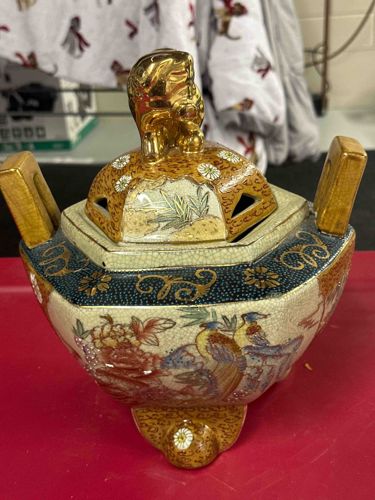
This item is a Japanese Satsuma-style koro, or incense burner, crafted from finely crackled ceramic. It features an octagonal body with a fitted lid and rests on three small, splayed feet. The dominant color palette includes rich blues, browns, greens, oranges, and reds, heavily accented with gilt detailing. The body of the koro is adorned with hand-painted scenes, including birds (possibly pheasants or similar exotic fowl), vibrant floral motifs (peonies, chrysanthemums), and lush foliage set against a cream-colored, deliberately crackled glaze background. Around the upper rim, there is a prominent band of dark blue, embellished with intricate gold scrollwork and small floral patterns. The lid echoes the octagonal shape of the body and features several pierced openings, likely for ventilation of incense smoke. It is also decorated with similar scenic elements and gilt patterns, alongside small white enameled floral accents. A striking golden Foo Dog or Shishi figure serves as the finial on top of the lid, acting as a handle while adding an element of protective symbolism. Two 'ear' handles, also finished in a crackled gold glaze, project from the sides of the koro, providing additional decorative and functional elements. The overall craftsmanship suggests a high level of artistic skill, typical of Satsuma ware from the late 19th to early 20th century. The crackled glaze is a characteristic feature of Satsuma pottery, often intentionally created to enhance its aesthetic appeal and suggest age. The gilded details are extensive and show some areas of wear or rubbing, consistent with age and handling, but generally remain vibrant. No overt damage such as chips or significant cracks are immediately visible from the provided images, indicating good preservation. The detailed painting and use of gold suggest this was a luxury item. The Foo Dog finial is well-sculpted, adding to the item's perceived value and authenticity.
AI Appraisal Report
This Japanese Satsuma-style koro presents as a fine example of late 19th to early 20th-century decorative ceramics. Based on my visual examination, the condition appears good, with no immediately visible chips or significant cracks. The presence of a finely crackled ceramic, vibrant multi-color enamels, extensive gilt detailing, and a Foo Dog finial are all consistent with authentic Satsuma ware from this period. The wear on the gilding is expected for an item of this age, suggesting authenticity rather than a later reproduction attempting perfect preservation. The detailed hand-painted scenes, including birds and various floral motifs, demonstrate a high level of craftsmanship. Comparables in the current market, particularly for well-preserved examples of koro from this era, tend to fall within this value range. Demand for genuine antique Japanese decorative arts, especially Satsuma ware with strong aesthetic appeal and characteristic features like a Foo Dog finial, remains steady among collectors. The luxurious nature of the original piece, evidenced by the intricate artwork and extensive gilding, contributes positively to its value. However, a significant limitation of this appraisal is the lack of a physical examination. To fully verify authenticity and condition, I would need to inspect the piece in person to check for hairline cracks, professional repairs, the quality and texture of the glaze and enamels, and the application of the gilding. The presence of a genuine artist's signature or workshop mark on the base, which cannot be determined from images alone, would also significantly impact the value and could potentially elevate it. Without this, I must base my assessment solely on visual attributes and historical market trends for similar pieces.