These notes were written by the person who submitted this item. Appraiser.AI has not verified them, and the AI's identification and estimate may rely on them.
AI Estimated Value
Not an official valuation
$150-250
AI estimate as of August 1, 2025 · verify with a professional before acting
AI-Generated · Verify before acting
Everything on this page is generated by AI for informational purposes only. AI can make mistakes — the AI may misidentify items or misattribute them (artist, maker, brand, designer, origin, era). This is not an official valuation and should not be used for insurance, sale, tax, estate, legal, or lending purposes — or any decision requiring a certified appraisal. It is not an authoritative claim about any person, brand, or rights holder — do not share or rely on it as a factual statement about a third party. Always consult qualified professionals before making financial decisions.
This analysis also relies on unverified notes provided by the user, which may be incomplete or inaccurate and could affect the result.
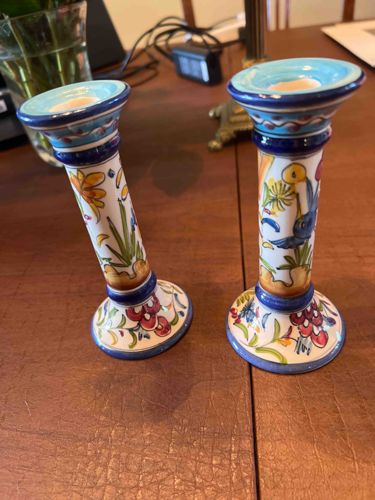
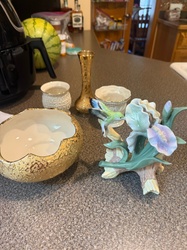
This is a pair of ceramic candlestick holders, likely originating from Portugal, given the additional context. Each candlestick features a trumpet-shaped top, designed to hold a taper candle, and flares out into a stable, circular base. They appear to be handcrafted from pottery, finished with a high-gloss glaze. The primary colors are a vibrant blue, red, yellow, green, and orange, set against an off-white or cream background, typical of traditional Portuguese hand-painted ceramics. The decoration is rich with floral motifs and foliage. One candlestick also features a charming depiction of a bird-like creature. The rim of the candle holder and the edge of the base on both pieces are adorned with a deep, cobalt blue band, often seen in Portuguese pottery. Intricate wave patterns or abstract designs in blue and turquoise are present just below the candle cup. The craftsmanship suggests hand-painting, with slight variations in the motifs between the two pieces, indicating individual artistry rather than mass machine production. There are no readily visible chips, cracks, or significant damage, suggesting they are in good condition. The interior of the candle cups shows some residual wax, consistent with their use. No distinct maker's marks or signatures are visible in the provided images, but the style strongly aligns with Portuguese artistic traditions, possibly from the mid to late 20th century.
AI Appraisal Report
Based on my visual examination of the provided images, these Hand-Painted Portuguese Ceramic Candlestick Holders are in remarkably good condition. I observe no visible chips, cracks, or significant damage, which is excellent for ceramic items of this presumed age. The presence of residual wax in the candle cups is consistent with their functional use and does not detract from their value. The vivid primary colors against the off-white background, along with the distinct floral motifs and the cobalt blue banding, are highly characteristic of traditional Portuguese pottery, lending strong authenticity to their stated origin. The slight variations in hand-painting between the two pieces further support their artisanal creation rather than mass production.
In terms of market conditions, there is a consistent, though not exceedingly high, demand for decorative Portuguese ceramics, especially hand-painted pieces that exemplify traditional artistry. Comparables in similar condition and style, often found from mid to late 20th century production, typically command prices in the mid-range for decorative arts. These items, while appealing, are not exceedingly rare, which moderates their top-tier value. Factors impacting value include their excellent condition, the appealing hand-painted decoration, and their status as a pair. The absence of a visible distinct maker's mark prevents an immediate link to a highly collectible atelier, which might otherwise increase their value significantly.
It is crucial to note the limitations of assessing authenticity and condition from images alone. A physical in-person examination would allow for a tactile assessment of the ceramic body, a more precise evaluation of the glaze's integrity, and the detection of hairline cracks or repairs not visible in photographs. Furthermore, under UV light, I could potentially identify past restorations or touch-ups. For full authentication and to ascertain a definitive dating, I would ideally look for specific maker's marks or signatures, which are critical for linking pieces to known studios or artists. Provenance documentation, such as original purchase receipts or family history, would also be invaluable in confirming their origin and age. Without these, my appraisal relies primarily on stylistic analysis and visible condition.