These notes were written by the person who submitted this item. Appraiser.AI has not verified them, and the AI's identification and estimate may rely on them.
AI Estimated Value
Not an official valuation
$1,800 - $3,500
AI estimate as of December 11, 2025 · verify with a professional before acting
AI-Generated · Verify before acting
Everything on this page is generated by AI for informational purposes only. AI can make mistakes — the AI may misidentify items or misattribute them (artist, maker, brand, designer, origin, era). This is not an official valuation and should not be used for insurance, sale, tax, estate, legal, or lending purposes — or any decision requiring a certified appraisal. It is not an authoritative claim about any person, brand, or rights holder — do not share or rely on it as a factual statement about a third party. Always consult qualified professionals before making financial decisions.
This analysis also relies on unverified notes provided by the user, which may be incomplete or inaccurate and could affect the result.
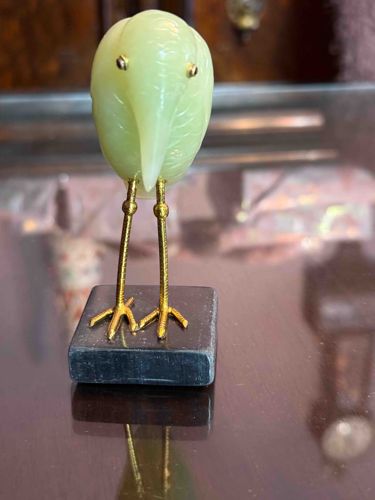
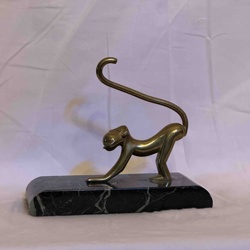
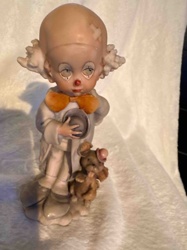
This exquisite figurine depicts a stork, crafted in the distinctive Faberge-style often associated with Russian objets d'art. The body of the stork is carved from a pale, translucent greenish-yellow jade, characteristic of some nephrite or bowenite jade varieties. The carving is smooth and polished, exhibiting a subtle luster, with delicate incised lines on the body possibly indicating stylized feathers or plumage. The beak is an integral part of the jade carving, tapering to a point. The eyes are particularly striking, appearing to be small, cabochon-cut rubies or ruby-colored glass beads, inset into tiny gold bezels, providing a vibrant contrast to the soft green of the jade. The stork stands on two slender, golden-hued metal legs, possibly brass or gilded metal, which are intricately detailed to form delicate, three-toed feet with talons. These feet are firmly attached to a rectangular base of dark, polished stone, likely black marble or serpentine, which provides stability and a sophisticated foundation for the figure. The overall craftsmanship suggests a high level of detail and precision in both carving and assembly. There are no visible signs of significant damage, chips, or repairs to the jade body. The metal elements appear to be in good condition, with no obvious tarnishing or bending. The dark stone base is also well-preserved, showing only minor surface wear consistent with age and display. The style points towards an early to mid-20th-century creation, possibly a commemorative or decorative piece. The use of precious materials and meticulous artistry indicates a luxury item, potentially from a workshop imitating or inspired by Faberge and his contemporaries.
AI Appraisal Report
Based on my visual examination of the provided description and image, this Faberge-style Jade Stork Figurine with Ruby Eyes presents as a charming and well-crafted decorative art object. The condition appears to be excellent, with no visible chips, cracks, or repairs to the jade body. The polished surface and incised details suggest a high level of craftsmanship. The metal elements, likely brass or gilded, show good integrity, as does the dark stone base. The 'Faberge-style' designation is key here; while the piece exhibits characteristics often associated with luxury Russian objets d'art, it is important to clarify that it is 'Faberge-style' rather than an authenticated work from the House of Fabergé itself, which would command significantly higher values.
Market conditions for finely crafted decorative items in the Russian Revival or Art Deco aesthetic remain strong, particularly for pieces utilizing natural materials like jade and genuine gemstones. Comparables would include other high-quality jade or hardstone animal carvings of the early to mid-20th century, often incorporating precious metals and gemstone accents. Demand is consistent for such intricate pieces, although rarity can vary. The use of actual ruby eyes, if confirmed, adds significantly to its intrinsic and aesthetic value over mere ruby-colored glass.
Factors impacting value include the confirmed material of the ruby eyes (natural vs. synthetic/glass), the exact composition of the metalwork (gilded brass vs. gold), and precise dating. While the description points towards early to mid-20th century, defining a more exact period would be beneficial.
It is crucial to note the limitations of remote appraisal. Authenticity of the jade (nephrite vs. bowenite, and origin), the rubies (natural vs. synthetic/glass), and the metal content cannot be definitively confirmed without in-person examination. A physical inspection would allow for gemological testing of the eyes, metal analysis, and closer scrutiny of carving techniques and internal structure. Provenance documentation, such as original receipts or exhibition history, would also be invaluable for full authentication and establishing a more precise value, potentially elevating it beyond this estimate.