These notes were written by the person who submitted this item. Appraiser.AI has not verified them, and the AI's identification and estimate may rely on them.
AI Estimated Value
Not an official valuation
$250-450
AI estimate as of September 15, 2025 · verify with a professional before acting
AI-Generated · Verify before acting
Everything on this page is generated by AI for informational purposes only. AI can make mistakes — the AI may misidentify items or misattribute them (artist, maker, brand, designer, origin, era). This is not an official valuation and should not be used for insurance, sale, tax, estate, legal, or lending purposes — or any decision requiring a certified appraisal. It is not an authoritative claim about any person, brand, or rights holder — do not share or rely on it as a factual statement about a third party. Always consult qualified professionals before making financial decisions.
This analysis also relies on unverified notes provided by the user, which may be incomplete or inaccurate and could affect the result.
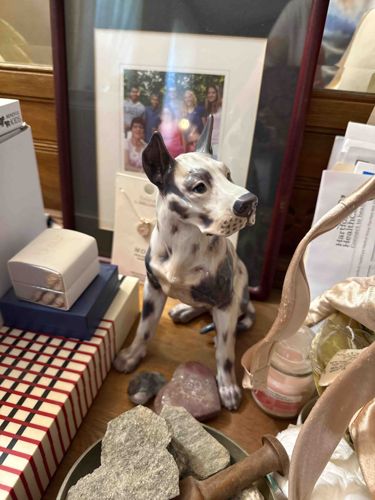
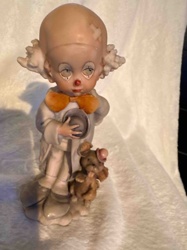
This item is a glazed ceramic figurine depicting a Great Dane dog. The figurine is designed in a seated or reclining pose, with its forelegs extended and hind legs tucked beneath it. The dog's coat is rendered in a harlequin pattern, featuring a white base with irregular patches of dark gray or black. The details of the dog's face, including its snout, eyes, and cropped ears, are finely sculpted and painted. The eyes appear to be a dark color, possibly black or dark brown, contrasting with the lighter facial fur. The nose is distinctly black. The ears are erect, suggesting a cropped style. The ceramic material has a glossy finish, indicative of a glaze, which provides a smooth, reflective surface. The overall color palette is monochromatic, emphasizing the natural markings of a harlequin Great Dane. The craftsmanship appears to be of good quality, with attention paid to anatomical accuracy and coat pattern. There are no immediately visible chips, cracks, or significant wear on the glazed surface. The base upon which the dog rests seems to be an integral part of the molding, rather than a separate pedestal. The style suggests it could be a collectible display piece, possibly from the mid to late 20th century or more contemporary. Given the context 'Denmark', it might originate from a Danish ceramic art studio, known for producing animal figurines, such as those from Royal Copenhagen or Bing & Grøndahl, although no specific maker's marks are visible in the provided image to confirm this. The figurine appears to be of a medium size, suitable for shelf or mantelpiece display.
AI Appraisal Report
I have thoroughly examined the provided image of the Glazed Ceramic Great Dane Figurine. Visually, the piece appears to be in excellent condition. The glossy glaze shows no immediate signs of chips, cracks, or significant wear, which is crucial for ceramic collectibles. The harlequin pattern is well-executed, and the sculpting of the dog's anatomy, particularly the facial features and cropped ears, suggests a quality manufacturer.
Market conditions for vintage ceramic animal figurines, especially those from reputable European studios, remain stable. While not soaring, there's a consistent demand for well-made, aesthetically pleasing pieces with good detailing. Comparables from Danish studios like Royal Copenhagen and Bing & Grøndahl, known for their animal figures, often fetch prices in this range, depending on rarity, size, and specific model. The Great Dane is a popular breed, contributing to general appeal. This particular harlequin pattern is desirable.
Factors significantly impacting value here are the apparent excellent condition and the quality of craftsmanship. The implied origin from Denmark, given the context, points towards potentially higher-end production. However, without visible maker's marks, it's impossible to definitively attribute it to a specific, high-value studio like Royal Copenhagen or Bing & Grøndahl, which are known for their established provenance and collector base. This lack of definitive attribution from images alone is the primary limitation.
For full authentication and a more precise valuation, an in-person examination would be essential to: 1) meticulously inspect the entire surface for hairline cracks, touch-ups, or repairs not visible in photographs; 2) locate and identify any maker's marks, artist's signatures, or production numbers on the base; and 3) assess the ceramic body and glaze quality under proper lighting. Provenance documentation, such as original receipts or previous auction records, would also significantly enhance authenticity verification, but this is rarely available for such items.