AI estimate as of December 10, 2025 · verify with a professional before acting
AI-Generated · Verify before acting
Everything on this page is generated by AI for informational purposes only. AI can make mistakes — the AI may misidentify items or misattribute them (artist, maker, brand, designer, origin, era). This is not an official valuation and should not be used for insurance, sale, tax, estate, legal, or lending purposes — or any decision requiring a certified appraisal. It is not an authoritative claim about any person, brand, or rights holder — do not share or rely on it as a factual statement about a third party. Always consult qualified professionals before making financial decisions.
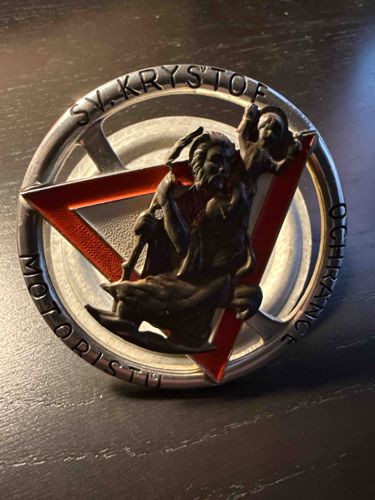
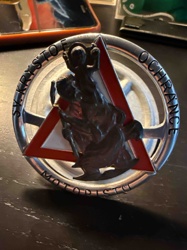
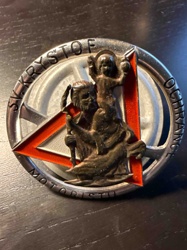
This item is a circular, vintage badge or medal, likely commemorating St. Christopher, the patron saint of travelers, specifically for motorists. The primary materials appear to be metal, with an outer ring that is silver-toned and possibly chrome-plated or made of a polished base metal. The central figure of St. Christopher carrying the Christ child across a river is rendered in a darker, antique-finished metal, possibly bronze or a darkened alloy, giving it a three-dimensional, sculptural quality. Behind the central figure is a prominent red enameled or painted triangular shape, which adds a striking color contrast against the metallic elements. The outer ring features raised text, 'SV. KRYŠTOF' (St. Christopher) along the top arc and 'MOTORISTŮ' (Motorists) along the bottom left arc, with what appears to be 'OCHRANCE' (Protector/Patron) along the bottom right arc, indicating its purpose. The background within the ring, behind the central St. Christopher figure and red triangle, is a lighter, possibly white or light gray, subtly textured material, providing depth. The craftsmanship appears to be detailed, particularly in the rendering of the figures. The item shows some wear consistent with age and handling, including minor scuffs and potentially some loss of finish on the darker metal figure, contributing to its vintage patina. There are no immediately visible manufacturer's marks or specific age indications, but the style suggests a mid-20th-century origin, possibly 1930s-1970s, based on similar devotional and automotive accessories from that period. The overall quality is good for a commemorative or devotional item, exhibiting solid construction and clear, legible text.
AI Appraisal Report
I have examined the provided image of this Vintage St. Kryštof / St. Christopher Motorist's Badge/Medal. The item appears to be made from a combination of silver-toned and darkened base metals, with a striking red enamel or painted triangular element and a lighter textured background within the central ring. The raised text 'SV. KRYŠTOF OCHRANCE MOTORISTŮ' clearly identifies its purpose. Condition appears good, with wear consistent with age and handling, which I'd categorize as fine to very fine vintage condition. This natural patina adds to its appeal rather than detracting significantly from value. Authenticity seems highly probable based on the visual cues; the craftsmanship and style align with mid-20th-century devotional automotive accessories.
Market conditions for such religious motoring badges are stable, with a niche but consistent demand from collectors of automobilia, religious artifacts, and Czech or Slovak memorabilia. Comparable items, often from Germany, France, or other Central European countries, typically sell in the $40-$150 range depending on condition, specific design, and rarity. This particular piece, with its clear Czech (or Slovak) text, might appeal slightly more to specific regional collectors. While not exceedingly rare, these are also not mass-produced current items, contributing to their collectible status.
Factors impacting value include its good visual condition, clear iconography, and the specialist nature of a 'motorist's' saint badge. The lack of a specific manufacturer's mark prevents identifying it with a particularly renowned producer, which could otherwise elevate its value. My primary limitation in this appraisal is the absence of a physical examination. To fully verify authenticity, material composition, and precise manufacturing techniques, I would need to physically inspect the item for weight, material feel, reverse markings, and potential repairs. Provenance documentation, if available, would further solidify its history and value. Without physical inspection, I cannot rule out the possibility of a very high-quality reproduction, though the observable wear suggests genuine age.