AI estimate as of October 13, 2025 · verify with a professional before acting
AI-Generated · Verify before acting
Everything on this page is generated by AI for informational purposes only. AI can make mistakes — the AI may misidentify items or misattribute them (artist, maker, brand, designer, origin, era). This is not an official valuation and should not be used for insurance, sale, tax, estate, legal, or lending purposes — or any decision requiring a certified appraisal. It is not an authoritative claim about any person, brand, or rights holder — do not share or rely on it as a factual statement about a third party. Always consult qualified professionals before making financial decisions.
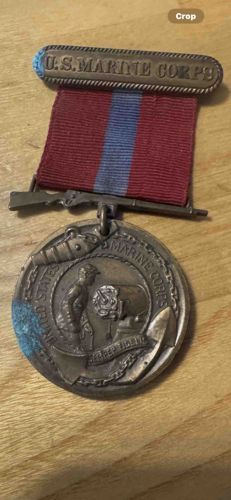
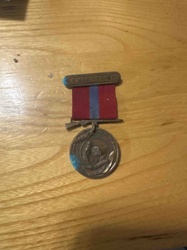
This item is an antique or vintage U.S. Marine Corps marksmanship medal, likely dating from the early 20th century. It consists of a bronze or similar base metal planchet suspended from a ribbon, which in turn is attached to a top bar. The top bar is rectangular with rounded ends, featuring 'U.S. MARINE CORPS' in raised lettering framed by a decorative beaded border. The ribbon displays vertical stripes of red on the outer edges and a central blue stripe. Below the ribbon, a detailed miniature rifle, possibly a M1903 Springfield or a similar period service rifle, is affixed horizontally, acting as an intermediary suspension device for the circular medal. The circular medal itself depicts a Marine figure, possibly a 'devil dog' from WWI era iconography, aiming a rifle. Behind the Marine, a cannon or artillery piece is visible, reinforcing the military context. The inscription 'UNITED STATES MARINE CORPS' encircles the upper half of the medal's design, while a banner below the central figures reads 'SHARPER THEN' (the last word seems to be partially obscured or worn). The medal exhibits a dark, aged patina consistent with bronze or brass that has oxidized over time, giving it a somewhat dull, dark brown appearance. There is noticeable wear on the raised details of both the top bar and the medal itself, indicating age and handling. A distinct bluish-green oxidation or verdigris is visible in some recessed areas of the medal, particularly on the left side near the 'UNITED STATES' inscription, which is a common characteristic of aged copper alloys. The ribbon appears somewhat faded and creased, but its colors are still discernible. The overall craftsmanship suggests a period-correct military award, with good detail for its size and material.
AI Appraisal Report
I have examined the provided image of this U.S. Marine Corps Sharpshooter Marksmanship Medal, identifying it as an early 20th-century piece. Visually, the medal appears authentic for the period. The design elements, including the 'U.S. MARINE CORPS' top bar, the specific ribbon configuration (red-blue-red), the miniature rifle suspension, and the Marine aiming a rifle with a cannon background, are consistent with known examples of early USMC marksmanship awards. The dark, aged patina and the presence of bluish-green verdigris in recessed areas strongly suggest an original bronze or copper-alloy composition that has oxidized naturally over time. The wear on raised details and the fading/creasing of the ribbon are also indicative of age and typical handling, rather than artificial aging.
Market conditions for early 20th-century USMC medals are generally stable, with a consistent demand from military collectors. While not exceptionally rare, early marksmanship medals in good, original condition, especially those with the distinctive rifle suspension like this Sharpshooter variant, are sought after. The 'SHARPER THEN' inscription, though partially obscured, appears to be an authentic detail. Factors impacting value include the overall good, original condition, the lack of significant damage beyond expected wear, and its historical appeal.
However, it is crucial to recognize the limitations of authentication based solely on images. While the visual cues are positive, a definitive authentication would require an in-person examination. This would allow for a tactile assessment of weight, detailed inspection of attachment methods, verification of metal composition (e.g., specific gravity or spectroscopy for bronze/brass), close-up analysis of manufacturing marks, and a more thorough examination of the ribbon's material and weave. Documentation of the medal's provenance, such as original award papers or historical ownership records, would significantly enhance its authenticity and value. Without physical inspection, I cannot rule out the possibility of a high-quality reproduction, though visual evidence strongly points to originality.