AI estimate as of December 3, 2025 · verify with a professional before acting
AI-Generated · Verify before acting
Everything on this page is generated by AI for informational purposes only. AI can make mistakes — the AI may misidentify items or misattribute them (artist, maker, brand, designer, origin, era). This is not an official valuation and should not be used for insurance, sale, tax, estate, legal, or lending purposes — or any decision requiring a certified appraisal. It is not an authoritative claim about any person, brand, or rights holder — do not share or rely on it as a factual statement about a third party. Always consult qualified professionals before making financial decisions.
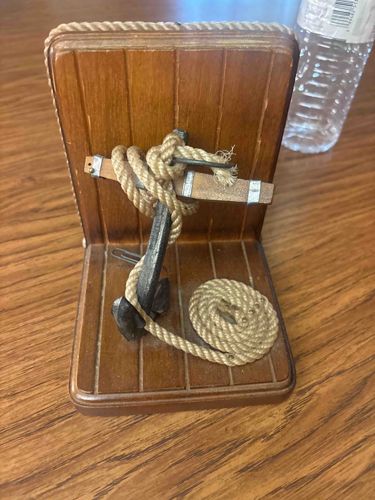
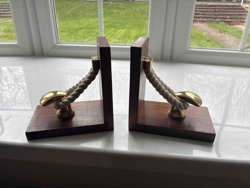
This appears to be a single, decorative bookend with a distinct nautical theme. It is constructed primarily from wood with a warm, medium-brown stain, likely simulating oak or teak, and features vertical grooves mimicking ship decking or planking on both its base and upright support. The visible edge of the bookend is adorned with a 'rope' trim, suggesting a maritime aesthetic. The most prominent decorative element is a stylized anchor, likely cast metal (possibly painted or patinated iron or a similar alloy given its dark, somewhat uneven finish), secured with a length of natural fiber rope. The rope, which appears to be jute or hemp, is tied around the anchor's shank and fluke, and a portion of it is coiled neatly on the bookend's base, further enhancing the seafaring motif. A small, light-colored wooden 'spreader' bar with silver-toned bands at each end is attached near the top of the anchor assembly, adding an additional detail to the rigging. There are visible signs of wear on the rope, with some frayed ends, particularly where it is tied to the anchor's stock. The wooden surfaces show a slight sheen, indicating a varnish or protective finish, and appear to be in good overall condition with no obvious chips or cracks, although minor scuffs consistent with use cannot be ruled out without closer inspection. The item's design suggests a style period from the mid-20th century to contemporary, aiming for a classic or rustic nautical decor. Its craftsmanship appears to be of moderate quality, suitable for decorative and functional use.
AI Appraisal Report
Based on my visual examination of the Nautical-Themed Wooden Bookend, I assess its condition as good, consistent with light to moderate use. The wooden components show a consistent finish with no obvious cracks or significant chips, suggesting a protective varnish. The metal anchor appears sturdy, and the overall assembly is intact. The natural fiber rope exhibits some fraying, particularly where tied, which is expected with age and handling of such material but does not detract significantly from its decorative appeal. Authenticity as a functional bookend with decorative intent is clear.
Limitations in authenticity verification arise from the image-only assessment. Without physical inspection, I cannot confirm the specific wood type, the exact composition of the metal anchor (e.g., cast iron, spelter, or another alloy), or the quality of its attachment points. I would also need to physically assess the stability of the bookend, its weight, and the overall construction quality to fully ascertain its functional durability. Provenance documentation could potentially elevate value if it linked this piece to a notable designer, artisan, or historical context, but given the generic nature, this is unlikely. Scientific testing is not typically required nor cost-effective for items of this type unless specific material identification is crucial for a unique reason.
Market conditions for decorative bookends, especially those with nautical themes, are moderate. Comparables readily available in online marketplaces, antique shops, and home decor stores suggest a broad range for similar items. Demand is consistent for classic 'coastal decor' pieces but rarely reaches high levels for mass-produced or moderately crafted examples. Rarity is low; similar items are produced by various manufacturers. Factors impacting value include its decorative appeal, functional utility, and condition. Given its generic design, lack of identifiable maker's marks, and moderate material quality, it commands an accessible price point within the home decor market.