AI Appraisal Estimate

AI-generated estimates · not official valuations

From the user

What was submitted

Photo and notes provided by the user — not generated by AI

Submitted item photo
Submitted photo · June 15, 2026

User's notes

No additional notes provided.

AI analysis below

AI appraisal

AI analysis & estimate

AI-Generated · Verify before acting

Everything below is generated by AI for informational purposes only. AI can make mistakes — the AI may misidentify items or misattribute them (artist, maker, brand, designer, origin, era). This is not an official valuation and should not be used for insurance, sale, tax, estate, legal, or lending purposes — or any decision requiring a certified appraisal. It is not an authoritative claim about any person, brand, or rights holder — do not share or rely on it as a factual statement about a third party. Always consult qualified professionals before making financial decisions.

Read the full disclaimer

AI Identification

·Not independently authenticated·Verify before acting

Vintage Green Uranium Glass Citrus Juicer Reamer with Measuring Pitcher

Vintage Glassware / Kitchenalia

AI Estimated Value

·Not an official valuation·Verify before acting

$45.00-$75.00

As of June 15, 2026

AI Item Analysis

·AI can make mistakes·Verify before acting
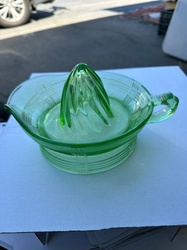
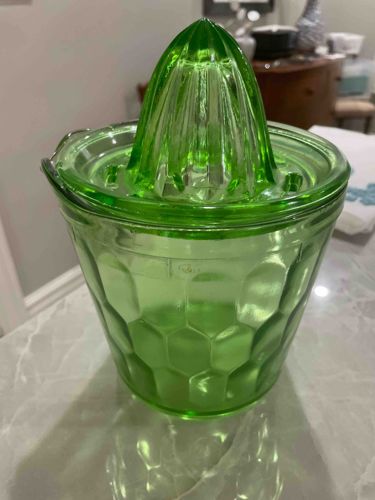
This is a two-piece vintage citrus juicer set crafted from vibrant green transparent glass, highly indicative of Depression-era uranium glass (Vaseline glass), which would likely exhibit a fluorescent green glow under ultraviolet light. The set consists of a pointed conical reamer top with deep vertical scoring for extracting juice and a matching juice collector/measuring cup base. The base features a distinctive pressed glass pattern of repeating hexagonal 'honeycomb' or 'thumbprint' facets that cover the cylindrical body, tapering slightly toward the bottom. It includes a molded handle and a wide pour spout for easy serving. The glass possesses a heavy, substantial feel characteristic of high-quality mass-produced kitchenware from the 1930s. The overall condition appears excellent with good clarity, though typical for its age, one might find minor mold lines, cooling marks, or tiny 'seed' bubbles within the glass. There is no significant visible chipping on the sharp edges of the reamer ridges, which is a common site for damage on these utilitarian pieces. The craftsmanship reflects the industrial art style of the early 20th century, combining functionality with a decorative aesthetic that remains highly collectible today.
AI Appraisal Report

·AI can make mistakes·Verify before acting
I have examined the digital images of this two-piece green citrus juicer set. The item exhibits the characteristic 'springtime green' coloration and translucency synonymous with Depression-era glass production. The presence of a honeycomb/thumbprint pressed pattern on the measuring base, combined with the structural design of the reamer insert, suggests this is an authentic piece from the 1930s, likely produced by a firm such as Hazel-Atlas or Federal Glass. The condition appears exceptional; the reamer ridges, which are prone to 'flea bites' and chipping, show no significant degradation, and the glass clarity remains high without the 'sick glass' clouding often caused by modern dishwashers. Market demand for 'Kitchenalia' and Uranium glass remains steady, though values have plateaued compared to previous decades. Collectors currently favor multi-piece sets over individual reamers. Comparables for similar two-piece sets in excellent condition typically realize between $40 and $80 at specialty antique malls or online auctions. The 'glow' factor (UV reactivity) is a primary driver for value in this niche. Limitation of Authenticity: While the visual markers are consistent with period production, a definitive appraisal is limited by the digital format. To fully authenticate this item and confirm the higher end of the valuation, an in-person inspection under a 365nm ultraviolet light is required to confirm the presence of uranium oxide (fluorescence). Furthermore, physical tactile inspection is necessary to detect microscopic chips or structural stress fractures not visible in photographs. Provenance documentation or a manufacturer's mark (often found faintly on the interior base) would further solidify its origin.

Get your items appraised

Instant estimates of your treasures with AI-powered appraisals

Browse More Appraisals